
Ask Forstrong
Halftime Report:
Is The Rotation For Real?
July 2026
Ask Forstrong: The Magnificent 7 has carried markets for years. Is this year’s weakness just noise or the beginning of a new market regime?
Key Takeaways
- The market no longer needs seven stocks to carry it forward. Leadership is broadening across sectors, styles and regions.
- AI is getting bigger, not smaller. The next winners won’t be the builders of AI but the companies and countries putting it to work.
- Forstrong’s “Rise of the Rest” Super Trend is underway. Higher interest rates and improving earnings are creating compelling opportunities well beyond the Mag 7.
What a World Cup this has been. Tearful farewells. Stunning upsets. New heroes. Cristiano Ronaldo’s emotional exit from the international stage. Traditional powerhouses like Brazil and Germany knocked out by Norway and Paraguay. And, of course, Canada’s inspiring run to the Round of 16, lifting the national mood in a way few sporting events can.
The lesson is obvious: yesterday’s champions are not guaranteed tomorrow’s success.
Financial markets are telling a similar story. For much of the last decade, the investment playbook was simple: own America’s mega cap technology stocks. When they rose, the S&P 500 rose with them. When they stumbled, the broader market usually followed. That relationship has begun to break down. The once-vaunted Mag 7—a useful, if imperfect, proxy for the AI hyperscalers—has struggled this year. The group of seven, as our friends at Deutsche Bank point out, has even managed to underperform one of the year’s worst-performing asset classes: long-dated UK government bonds.
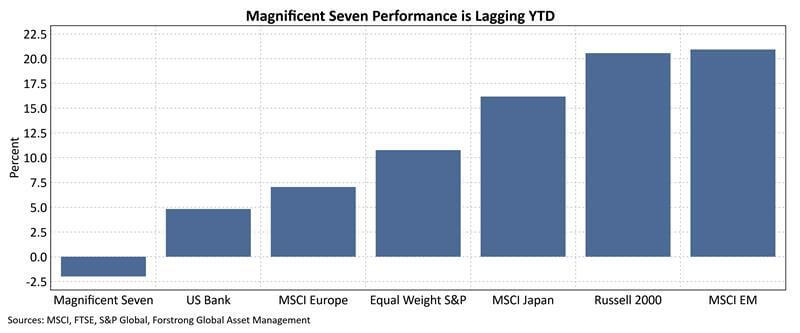
Meanwhile, a very different set of winners has emerged. US small cap stocks have delivered their strongest first half in 35 years. Japan has quietly carved out its best quarterly equity performance since 1986. Emerging markets have comfortably outperformed developed markets. Value has beaten growth. Equal-weighted indices have outperformed their cap-weighted cousins. Even within technology, leadership has begun to broaden beyond the familiar megacap names.
To be fair, 2026 has been a messy year. Some of this may simply reflect investors taking profits after an extraordinary run in the Mag 7. And recent leadership hasn’t exactly been easy to decipher. Over the past month, the best performing sectors in the US have been financials, industrials, healthcare and utilities—two cyclical groups and two defensive ones. Can you see a pattern? Yeah, we can’t either.
But our investment team believes something more important is unfolding. The market no longer needs seven stocks to carry it forward. Leadership is broadening. The opportunity set is widening. And unlike many previous false starts, we believe this rotation has legs.
Here’s why.
1. The AI Story Is Getting Bigger
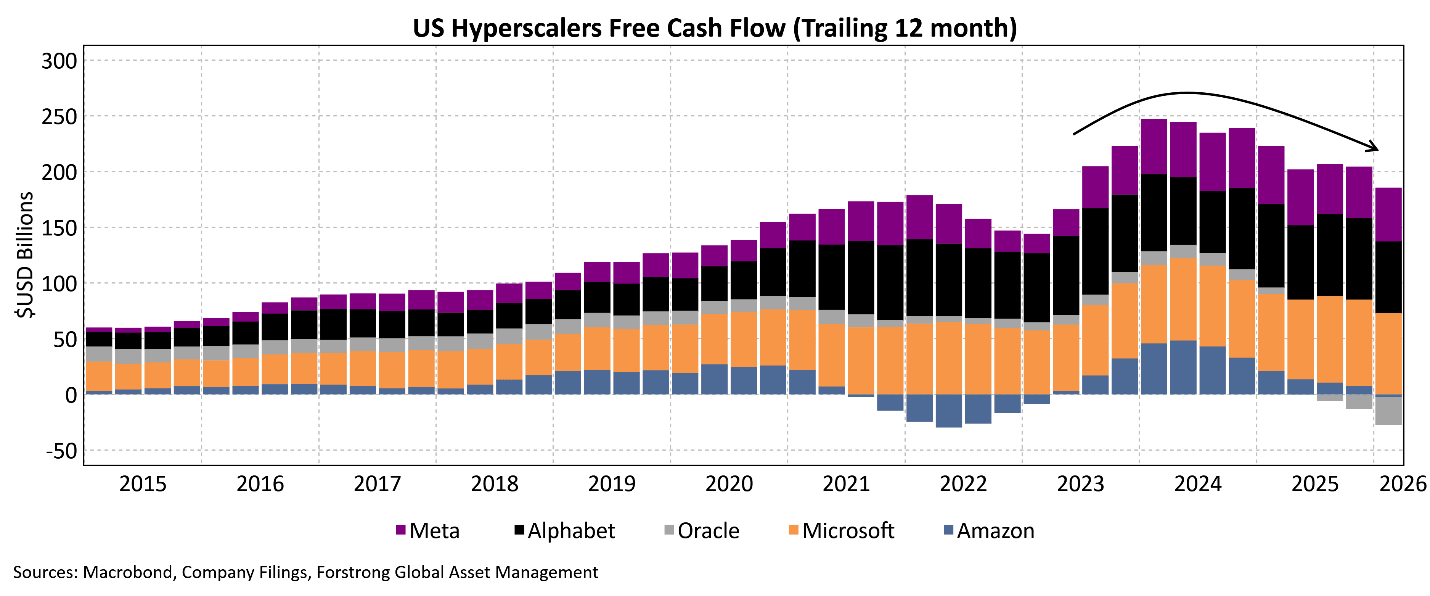
Much of the recent underperformance in the Mag 7 reflects a simple reality: investors are becoming more demanding. For the past three years, markets rewarded companies simply for spending aggressively on AI. Today, investors want proof that those investments will generate attractive returns.
That is becoming a much tougher test. Alphabet, Amazon, Microsoft and Meta continue to pour hundreds of billions of dollars into AI infrastructure. But free cash flow has come under pressure as data centres become more expensive and the costs of memory chips, networking equipment and power infrastructure continue to climb. All four major hyperscalers reported negative year-on-year growth in 12-month trailing free cash flow in the first quarter.
As we wrote in our February 2026 Ask Forstrong:
“Big Tech is no longer an asset-light monopoly franchise. It is now capital-hungry, more competitive and less insulated. Markets assign very different multiples to that kind of business model.”
None of this means the AI story is broken. Far from it. If anything, AI is becoming much bigger than the companies that started it. The market is already rewarding many of the businesses supplying the AI buildout, from semiconductor manufacturers to electrical equipment, power infrastructure and industrial automation.
But history suggests the next phase will look different. Every major technological revolution follows a similar path. First comes the infrastructure. Then come the applications. The internet offers a useful comparison. Cisco built much of the plumbing. But the greatest long-term value accrued to companies like Amazon and Google that found profitable ways to use it.
AI will likely follow the same path. The biggest winners won’t simply build the models. They’ll use AI to improve productivity, lower costs and grow earnings in industries like healthcare, robotics, manufacturing, logistics and defence. That transition won’t happen overnight. There will almost certainly be periods when enthusiasm for AI infrastructure runs ahead of reality—as this year’s parabolic rally in semiconductor stocks reminds us.
But the bigger point remains intact. AI is no longer a story about seven companies. It is becoming an economy-wide investment and capital spending cycle. The AI race has unleashed one of the largest investment booms of the modern era, rivaling anything seen outside the industrial mobilization of the Second World War. It is fueling a surge in construction, power generation, banking, credit, mergers and acquisitions, equity issuance and asset management as governments and corporations race to finance the next wave of innovation.
Portfolio Playbook
- Stay invested in AI but broaden exposure beyond the hyperscalers.
- Look for second-order beneficiaries: companies and sectors applying AI to improve productivity and lift earnings, not just those building the underlying infrastructure.
- Continue owning the global “picks and shovels” of AI, including semiconductor leaders in Taiwan and Korea, but also industrial automation in Japan, and the raw materials like copper companies required to power the buildout.
2. Higher Rates Are Changing the Rules of the Game
For most of the post-Global Financial Crisis era, investors enjoyed an extraordinary tailwind: interest rates kept falling. That mattered because lower discount rates made future earnings more valuable. Investors were willing to pay almost any price for companies promising rapid growth years—even decades—into the future. It was the ideal backdrop for long-duration assets like technology.
That world is over. Money has a cost again.
Despite repeated hopes for lower rates, inflation has proven far stickier than expected. This has been one of Forstrong’s defining Super Trends for years—and one that has served our clients well. Massive fiscal deficits, reindustrialization, defence spending and energy security all point to a world where interest rates are likely to remain structurally higher than they were during the 2010s.
That changes the rules of the game. And when the rules change, so do the winners. Investors become less willing to pay for distant promises and more interested in businesses generating cash flows today. It’s one of the biggest reasons leadership has broadened beyond a handful of mega cap technology stocks.
Banks benefit from stronger net interest margins. Insurers earn more on their investment portfolios. Industrials, energy and materials companies stand to gain from the rebuilding of infrastructure and manufacturing. Businesses that spent years in the market’s penalty box suddenly look much more attractive when capital once again carries a meaningful price.
Higher rates don’t immediately end bull markets. They simply change who leads them.
Portfolio Playbook
- Broaden exposure beyond long-duration growth stocks.
- Increase allocations to companies and sectors with pricing power that benefit from a higher-rate environment, including materials, industrials and select financials.
- Build portfolios that can thrive even if interest rates remain higher for longer (see our last piece for income investors “Bond Market Meltdown: A Survival Guide for Income Investors”).
3. The Rise of the Rest: Global Investing Is Back
For much of the past decade, investing outside the United States felt like an exercise in patience. Europe struggled with sluggish growth. Japan remained trapped in deflation. Emerging markets lurched from one crisis to the next. Meanwhile, America’s technology giants dominated earnings growth and attracted an ever-larger share of global capital.
That world is changing, too.
Germany alone plans to borrow more than €800 billion by 2030—the biggest fiscal pivot in modern history. After decades of restraint, Europe is rebuilding its military, modernizing infrastructure and strengthening energy security. Defence spending is set to reach levels not seen since the Cold War, creating a powerful tailwind for European industry.
Japan’s revival continues to gather momentum. Rising wages, improving corporate governance and shareholder-friendly reforms are finally unlocking value after decades of economic stagnation.
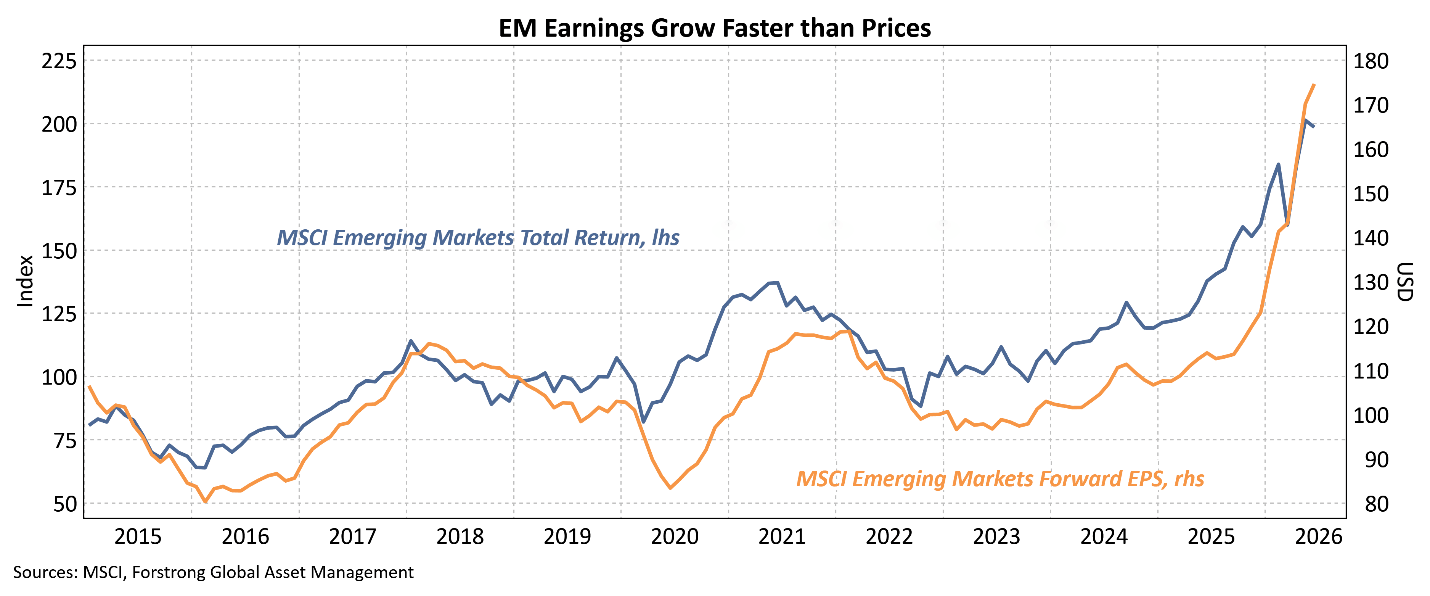
Emerging markets may offer the most compelling story of all. Many investors still think of the asset class as a risky value trap. We think they’re looking backward. The real story, looking ahead, is earnings. Forward earnings per share estimates have surged roughly 40% this year—well ahead of the market itself—driving valuations lower even as share prices have risen. In other words, earnings are growing faster than stock prices.
None of this means the AI story is broken. Far from it. If anything, AI is becoming much bigger than the companies that started it. The market is already rewarding many of the businesses supplying the AI buildout, from semiconductor manufacturers to electrical equipment, power infrastructure and industrial automation.
But history suggests the next phase will look different. Every major technological revolution follows a similar path. First comes the infrastructure. Then come the applications. The internet offers a useful comparison. Cisco built much of the plumbing. But the greatest long-term value accrued to companies like Amazon and Google that found profitable ways to use it.
AI will likely follow the same path. The biggest winners won’t simply build the models. They’ll use AI to improve productivity, lower costs and grow earnings in industries like healthcare, robotics, manufacturing, logistics and defence. That transition won’t happen overnight. There will almost certainly be periods when enthusiasm for AI infrastructure runs ahead of reality—as this year’s parabolic rally in semiconductor stocks reminds us.
But the bigger point remains intact. AI is no longer a story about seven companies. It is becoming an economy-wide investment and capital spending cycle. The AI race has unleashed one of the largest investment booms of the modern era, rivaling anything seen outside the industrial mobilization of the Second World War. It is fueling a surge in construction, power generation, banking, credit, mergers and acquisitions, equity issuance and asset management as governments and corporations race to finance the next wave of innovation.
Portfolio Playbook
- Look beyond the United States for the next generation of market leaders.
- Increase exposure to countries benefiting from structural investment themes, including Japan, Taiwan and parts of Europe.
- Focus on regions where earnings are accelerating, not simply where valuations appear inexpensive.
Bottom Line
The market no longer needs seven stocks to carry it forward. New leaders are emerging. The playbook that won the first half of this decade is unlikely to be the one that wins the second. Halftime is when great teams adjust their game plan. Investors should too.
Looking for perspective beyond the headlines?

Disclaimers:
The information contained in these materials is for general informational purposes only and is intended to provide only brief comments on broad market, industry or sector trends, or other general economic or market conditions. It is not intended to provide an overview of the terms applicable to any products or funds managed or sponsored by Forstrong Global Asset Management Inc. (“Forstrong”). Views expressed regarding a particular company, security, industry, investment, or market sector are the views only of that individual as of the time expressed and do not necessarily represent the views of Forstrong or any other person in the Forstrong organization. These materials contain information and views as of the date indicated and such information and views are subject to change at any time without notice, based upon market and other conditions, and Forstrong disclaims any and all responsibility to update such information and views. These views are not and may not be relied upon as investment advice and, because investment decisions for a Forstrong fund or product are based on numerous factors, are not and should not be relied upon as an indication of trading intent on behalf of any Forstrong fund or product. Any opinion or assumption may contain elements of subjective judgment and are not intended to imply, nor should be interpreted as conveying, any form of guarantee or assurance by Forstrong of any future action or performance. Neither Forstrong nor any of its affiliates, businesses, or representatives make any representation or warranty, express or implied, as to the accuracy, reliability, completeness, appropriateness, or sufficiency for any purpose of any information contained herein. Forstrong and its affiliates and related entities disclaim any and all liability relating to the information herein, including, without limitation, any express or implied representations or warranties for, statements contained in, and omissions from, the information. Forstrong and its affiliates and related entities are not liable for any errors or omissions in any information herein or for any loss or damage suffered, whether direct or consequential, resulting from the use of these materials.
The information contained in these materials is strictly for general illustrative, educational, or informational purposes, and is not intended to provide legal, investment, accounting, or tax advice, and should not be relied upon in that regard. These materials contain information and views as of the date indicated and such information and views are subject to change at any time without notice, based upon market and other conditions, and Forstrong disclaims any and all responsibility to update such information and views. These views are not and may not be relied upon as investment advice. Any opinion or assumption may contain elements of subjective judgment and are not intended to imply, nor should be interpreted as conveying, any form of guarantee or assurance by Forstrong of any future action or performance. Neither Forstrong nor any of its affiliates, businesses, or representatives make any representation or warranty, express or implied, as to the accuracy, reliability, completeness, appropriateness, or sufficiency for any purpose of any information contained herein. Forstrong and its affiliates and related entities disclaim any and all liability relating to the information herein, including, without limitation, any express or implied representations or warranties for, statements contained in, and omissions from, the information. Forstrong and its affiliates and related entities are not liable for any errors or omissions in any information herein or for any loss or damage suffered, whether direct or consequential, resulting from the use of these materials.
Any specific companies, issuers, funds, ETFs, or indices mentioned are for illustrative or educational purposes only and are not and shall not be deemed to be a recommendation to buy or sell any securities. Any companies, issuers, funds, or ETFs mentioned do not necessarily represent current or future holdings of any Forstrong funds or products. Any strategies discussed are strictly for illustrative and educational purposes and are not a recommendation, offer, or solicitation to buy or sell any securities or to adopt any investment strategy. There is no guarantee that any strategies discussed will be effective.
Commissions, fees, and expenses may be associated with investments in Forstrong funds, ETFs, and/or other investment products. Please read a fund’s offering memorandum or ETF’s prospectus, as applicable, which contains detailed information, and speak to an advisor before investing. Funds and ETFs are not guaranteed, their values change frequently, and investors may experience a gain or loss. Past performance may not be repeated.
Certain statements in these materials may contain forward-looking statements or forward-looking information that are predictive in nature and may include words such as “expects”, “anticipates”, “intends”, “plans”, believes”, “estimates”, and similar forward-looking expressions or negative versions thereof. Such forward-looking statements are based on current expectations and projections about future general economic, political, and other relevant market factors, such as interest, and assuming no changes to applicable tax or other laws or regulations. Expectations and projections about future events are inherently subject to, among other things, risks and uncertainties, some of which may be unforeseeable and, accordingly, may prove to be incorrect at a future date. Forward-looking statements are not guarantees of future performance, and actual events could differ materially from those expressed or implied in any forward-looking statements. A number of important factors can contribute to these differences, including, but not limited to, general economic, political, and market factors in Canada and internationally, interest and foreign exchange rates, global equity and capital markets, business competition, and catastrophic events. You should avoid placing any undue reliance on forward-looking statements. Past performance is no indicator of future performance and the materials are not intended to forecast or predict future events. Forstrong disclaims any and all responsibility to update any forward-looking statements, whether as a result of new information, future events, or otherwise, except as specifically required by law.
The information contained herein is presented solely for illustrative purposes and should not be construed as a forecast or projection. While some information used herein has been obtained from various published and unpublished third-party sources considered to be reliable, such information has not been independently verified by Forstrong (and Forstrong disclaims any obligation to verify) and Forstrong does not guarantee its accuracy or completeness and accepts no liability for any loss or damage suffered, whether direct or consequential, resulting from its use. It should be noted that data provided may be approximate numbers.
Forstrong Global® and the Forstrong Global® logo are trademarks or registered trademarks of Forstrong Global Asset Management Inc. in Canada.
© 2026 Forstrong Global Asset Management Inc. All rights reserved.