
Ask Forstrong
Bond Market Meltdown: A Survival Guide for Income Investors
May 2026
Ask Forstrong: I’m a retiree with a large allocation to Canadian and US government bonds.
I’m increasingly worried about inflation and the recent bond selloff. How should I position my portfolio here?
Key Takeaways
-
The world has shifted from a disinflationary regime to a structurally more inflationary one.
-
Government bonds are no longer the “safe haven” they once were.
-
Long-duration bonds, private credit, and illiquid mortgage strategies face growing risks.
-
Income investors should emphasize short duration, corporate credit, emerging market bonds, and high-dividend global equities.
- Global income diversification is crucial in a world of inflation, fiscal stress and geopolitical fragmentation.
2026 has been a banner year for the merchants of macro doom. War in Iran. Tankers rerouting around the Strait of Hormuz. AI mania bordering on religious fervor. Trump back in Beijing amid a historic oil shock. Sovereign debt spiralling higher. Everywhere you look, somebody is predicting either economic collapse or AI replacing half the workforce.
To be fair, team Forstrong has opined on it all too — in print, media, podcasts, and even back under the bright lights of business television (a process that involves considerably more face powder than one might expect). But amid all the chaos, investors are missing the bigger story quietly unfolding underneath it all: global government bonds are getting demolished. And for retirees and income investors raised on the idea that government bonds are “safe,” this may be one of the most important market shifts of the decade.
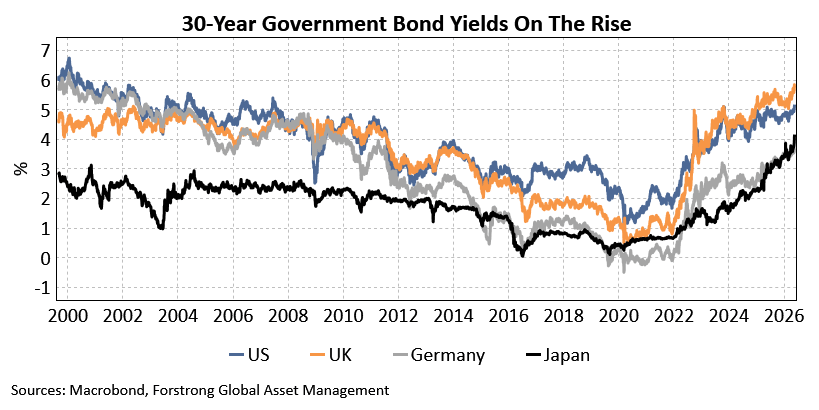
A quick tour of world bond markets tells the story. US 30-year Treasury yields recently crossed 5% at auction for the first time since 2007. Japan’s 30-year government bond touched 4% — an almost unimaginable number in a country that spent decades fighting deflation. German Bund yields are at their highest levels since 2011. UK gilts recently hit levels last seen in the late 1990s. Around the globe, bonds are being put through the mincing machine.
Inflation Running Hot
The culprit, of course, is inflation. And inflation is kryptonite for long-duration bonds. Back in 2021, we wrote that “the inflationary force had awakened” and that the world was witnessing “the beginning of the end of a 40-year period of disinflation.” At the time, many of the forces that defined the low-inflation world of the 2010s were beginning to fade.
Today, that view looks increasingly correct. Yes, US inflation has moderated from its June 2022 peak of 9.1%. And yes, some of the recent inflationary pressures tied to the Iran conflict may ultimately prove temporary. A de-escalation in the Middle East could restore energy and shipping flows and push oil prices sharply lower. We have also reminded clients over the last few months that oil shocks are less inflationary today than in the 1970s, largely because global oil consumption per unit of real GDP is just 35% of its level in the 1970s.
But don’t miss the bigger trend. Several structural forces are now pushing inflation persistently higher. Start with government policy. Say what you like about the Trump — and plenty do — but his administration is pursuing a policy mix that is simultaneously pro-growth and pro-inflationary.
Tariffs? Inflationary.
Lower immigration? Inflationary.
Politicizing the Fed? Inflationary.
Persistent fiscal deficits running near 6% of GDP alongside a massive wall of Treasury refinancing? Extremely inflationary.
Second, the world is in the midst of a global capex revolt. Ironically, the digital AI boom is reviving the physical economy — what we have called the “revenge of the real economy.” Since 2020, the world has experienced one of the strongest capex upcycles in decades. Industrial metals have surged even as Chinese real estate has struggled. This is not just about semiconductors. It reflects something much larger: rearmament, reindustrialization, and the rebuilding of global supply chains for a more fragmented geopolitical era. Years of chronic underinvestment — particularly in mining, energy, and infrastructure — left the world short of nearly everything that matters. The marginal unit of global growth is once again resource-intensive, capital-intensive, and massively inflationary.
Lastly, one of the world’s great inflation suppressors is quietly disappearing: China. For years, China exported deflation to the rest of the world. Cheap goods, excess industrial capacity, and falling export prices acted as a giant suppressant on global inflation. That anchor is now disappearing. Prices across several of China’s largest export categories — machinery, electrical equipment, and vehicles — have begun rising again. Global demand is finally strong enough to restore pricing power to China’s industrial base. In other words, one of the world’s great deflationary machines is quietly becoming inflationary.
Where to next? Investors are quickly realizing something uncomfortable: the world is not returning to the ultra-low inflation regime of the 2010s. Vibes are shifting quickly. Investors are moving from a disinflationary mindset to a debasement one — one where investors increasingly assume inflation will run structurally hotter, governments will continue to spend aggressively, and hard assets will matter again. The reality is that government bonds are no longer truly “risk free.” Most remain default-risk free. But they are no longer inflation-risk free. And that changes everything for the income investor.
Income Investor Survival Guide
Think about the traditional retiree portfolio for a moment. For decades, investors could comfortably allocate large portions of their savings to government bonds, clip coupons, and rely on falling inflation and declining interest rates to stabilize their portfolios. That playbook worked brilliantly for over 4 decades.
The problem is that the macro backdrop supporting it is now gone. So what should income investors avoid — and what should they embrace instead?
Income Assets To Avoid or Minimize
Long-Duration Government Bonds: If we are entering a world defined by persistent inflation and recurring supply shocks — rather than demand-led recessions — then long-duration bonds will no longer stabilize portfolios the way they once did. Instead, they can amplify volatility and generate substantial capital losses when yields rise. This is precisely what investors have experienced since the pandemic. The old assumption that bonds automatically hedge equity risk is becoming increasingly unreliable in a structurally inflationary world.
Private Credit: Private credit has become one of Wall Street’s biggest pressure points this year. To be clear, this is not 2008 all over again. Back then, US banks were levered roughly 30-to-1 and exposed to trillions in toxic mortgage securities. Today, banks are far less levered and direct exposure is relatively contained. That makes this less a systemic banking crisis and more a slower-moving liquidity and valuation problem. But the private credit boom was built on three assumptions: permanently low rates, endless liquidity, and easy refinancing conditions. Those assumptions no longer hold. After the 2008 financial crisis, regulators forced banks to retreat from risk-taking and private credit stepped in to fill the void. It worked brilliantly — until interest rates normalized. Now investors are discovering an uncomfortable truth: illiquid assets only feel liquid until everybody wants their money back at the same time.
Mortgage Funds: Canadian residential mortgage funds are increasingly facing many of the same pressures now emerging in private credit: deteriorating credit quality, illiquidity, and investors suddenly questioning valuations after years of assuming housing prices could only move higher. Higher interest rates, slowing population growth, stretched affordability, and rising condo inventory are exposing how dependent many mortgage strategies were on permanently rising home prices and easy refinancing conditions. Many mortgage funds offer the illusion of stability precisely because the underlying assets are infrequently priced. But illiquidity is not the same thing as low risk.
Income Assets To Include
Short-Duration Bonds: The flip side to long-duration bonds is short duration. Today, investors can earn reasonable yields without taking significant interest-rate risk or locking themselves into long-term assets that could lose value if inflation reaccelerates. In this environment, getting paid to stay liquid and flexible is a major advantage.
Corporate Credit: Our investment team remains constructive on corporate credit within income portfolios, although future gains are likely to be more modest given that credit spreads are already historically tight. Still, high-quality corporate bonds continue to offer an attractive combination of income, balance sheet strength, and relative value — particularly compared to increasingly indebted sovereign issuers. US federal debt has now surpassed 120% of GDP, while many investment-grade companies maintain leverage ratios below 2x EBITDA and continue to hold substantial cash reserves. Remarkably, parts of the market are now treating high-quality corporations as safer borrowers than governments themselves. That would have sounded absurd a decade ago. In parts of Europe and Asia, select AAA and AA-rated corporate bonds are now trading at yields below the government bonds of their own countries, reflecting greater investor confidence in corporate balance sheets than sovereign ones.
Emerging Market Bonds: One of the biggest surprises of this cycle has been the rise of emerging market bonds as a genuine source of safety and income. Ironically, many emerging markets now look more fiscally disciplined than the developed world. While many Western governments continue running deficits near 6–8% of GDP and carry debt burdens above 100% of GDP, several major emerging markets entered this period with healthier fiscal balances, stronger external accounts, and significantly higher real interest rates. Many emerging market central banks — including Brazil, Chile, and Mexico — also began raising interest rates well before the Federal Reserve, demonstrating a degree of policy discipline largely absent in the developed world. That early tightening helped bring inflation under control faster across much of the emerging world and has now opened the door to easing cycles and potential currency appreciation. The result is a rare combination for income investors: high yields, improving fundamentals, and diversification away from heavily indebted Western governments.
High-Dividend Global Equities: High-dividend equities remain one of the most attractive opportunities for income investors in a structurally inflationary world. Unlike bonds, companies can raise prices, grow revenues, and increase dividends over time. That matters enormously in an environment where inflation remains persistently above the levels investors became accustomed to during the 2010s. After being left for dead for much of the last decade, many international equity markets now offer dividend yields comparable to — and in some cases higher than — government bond yields. European equities currently yield roughly 3–4%, while several sectors across Asia, Latin America, and emerging markets offer dividend yields well above 5%, often supported by stronger balance sheets and lower valuations than their US peers. Investors are getting paid well to diversify globally.
Final Thoughts
Today’s income investor needs something different: broader diversification, shorter duration, real assets, selective credit exposure, and the flexibility to adapt as the macro backdrop evolves.
This is precisely why we built the Forstrong Global Income fund the way we did. Rather than relying on a single source of yield, the strategy sources income globally across sovereign bonds, corporate credit, dividend-paying equities, currencies, and real assets.
The old income playbook was built for a world of falling rates, stable geopolitics, and endless disinflation. Investors should assume that world is not coming back anytime soon.
Looking for perspective beyond the headlines?

Disclaimers:
The information contained in these materials is for general informational purposes only and is intended to provide only brief comments on broad market, industry or sector trends, or other general economic or market conditions. It is not intended to provide an overview of the terms applicable to any products or funds managed or sponsored by Forstrong Global Asset Management Inc. (“Forstrong”). Views expressed regarding a particular company, security, industry, investment, or market sector are the views only of that individual as of the time expressed and do not necessarily represent the views of Forstrong or any other person in the Forstrong organization. These materials contain information and views as of the date indicated and such information and views are subject to change at any time without notice, based upon market and other conditions, and Forstrong disclaims any and all responsibility to update such information and views. These views are not and may not be relied upon as investment advice and, because investment decisions for a Forstrong fund or product are based on numerous factors, are not and should not be relied upon as an indication of trading intent on behalf of any Forstrong fund or product. Any opinion or assumption may contain elements of subjective judgment and are not intended to imply, nor should be interpreted as conveying, any form of guarantee or assurance by Forstrong of any future action or performance. Neither Forstrong nor any of its affiliates, businesses, or representatives make any representation or warranty, express or implied, as to the accuracy, reliability, completeness, appropriateness, or sufficiency for any purpose of any information contained herein. Forstrong and its affiliates and related entities disclaim any and all liability relating to the information herein, including, without limitation, any express or implied representations or warranties for, statements contained in, and omissions from, the information. Forstrong and its affiliates and related entities are not liable for any errors or omissions in any information herein or for any loss or damage suffered, whether direct or consequential, resulting from the use of these materials.
The information contained in these materials is strictly for general illustrative, educational, or informational purposes, and is not intended to provide legal, investment, accounting, or tax advice, and should not be relied upon in that regard. These materials contain information and views as of the date indicated and such information and views are subject to change at any time without notice, based upon market and other conditions, and Forstrong disclaims any and all responsibility to update such information and views. These views are not and may not be relied upon as investment advice. Any opinion or assumption may contain elements of subjective judgment and are not intended to imply, nor should be interpreted as conveying, any form of guarantee or assurance by Forstrong of any future action or performance. Neither Forstrong nor any of its affiliates, businesses, or representatives make any representation or warranty, express or implied, as to the accuracy, reliability, completeness, appropriateness, or sufficiency for any purpose of any information contained herein. Forstrong and its affiliates and related entities disclaim any and all liability relating to the information herein, including, without limitation, any express or implied representations or warranties for, statements contained in, and omissions from, the information. Forstrong and its affiliates and related entities are not liable for any errors or omissions in any information herein or for any loss or damage suffered, whether direct or consequential, resulting from the use of these materials.
Any specific companies, issuers, funds, ETFs, or indices mentioned are for illustrative or educational purposes only and are not and shall not be deemed to be a recommendation to buy or sell any securities. Any companies, issuers, funds, or ETFs mentioned do not necessarily represent current or future holdings of any Forstrong funds or products. Any strategies discussed are strictly for illustrative and educational purposes and are not a recommendation, offer, or solicitation to buy or sell any securities or to adopt any investment strategy. There is no guarantee that any strategies discussed will be effective.
Commissions, fees, and expenses may be associated with investments in Forstrong funds, ETFs, and/or other investment products. Please read a fund’s offering memorandum or ETF’s prospectus, as applicable, which contains detailed information, and speak to an advisor before investing. Funds and ETFs are not guaranteed, their values change frequently, and investors may experience a gain or loss. Past performance may not be repeated.
Certain statements in these materials may contain forward-looking statements or forward-looking information that are predictive in nature and may include words such as “expects”, “anticipates”, “intends”, “plans”, believes”, “estimates”, and similar forward-looking expressions or negative versions thereof. Such forward-looking statements are based on current expectations and projections about future general economic, political, and other relevant market factors, such as interest, and assuming no changes to applicable tax or other laws or regulations. Expectations and projections about future events are inherently subject to, among other things, risks and uncertainties, some of which may be unforeseeable and, accordingly, may prove to be incorrect at a future date. Forward-looking statements are not guarantees of future performance, and actual events could differ materially from those expressed or implied in any forward-looking statements. A number of important factors can contribute to these differences, including, but not limited to, general economic, political, and market factors in Canada and internationally, interest and foreign exchange rates, global equity and capital markets, business competition, and catastrophic events. You should avoid placing any undue reliance on forward-looking statements. Past performance is no indicator of future performance and the materials are not intended to forecast or predict future events. Forstrong disclaims any and all responsibility to update any forward-looking statements, whether as a result of new information, future events, or otherwise, except as specifically required by law.
The information contained herein is presented solely for illustrative purposes and should not be construed as a forecast or projection. While some information used herein has been obtained from various published and unpublished third-party sources considered to be reliable, such information has not been independently verified by Forstrong (and Forstrong disclaims any obligation to verify) and Forstrong does not guarantee its accuracy or completeness and accepts no liability for any loss or damage suffered, whether direct or consequential, resulting from its use. It should be noted that data provided may be approximate numbers.
Forstrong Global® and the Forstrong Global® logo are trademarks or registered trademarks of Forstrong Global Asset Management Inc. in Canada.
© 2026 Forstrong Global Asset Management Inc. All rights reserved.