
2026 Super Trends Report
Double Vision:
Investing In A Split-Screen World
Table of Contents
Dear Clients, Colleagues and Friends,
If you feel a bit dizzy looking at the global economy right now, you aren’t alone. The 2020s were never going to be a quiet decade. Years of suppressed volatility, fiscal restraint and ultra-low interest rates built pressures that were always going to surface eventually. Still, few expected the midpoint of the decade to look quite like this — an economy that often appears to move in two directions at once.
We call this the Split-Screen World. On one side, the numbers look great. Equity markets have advanced, high-income households remain robust, and the first signs of an AI-driven productivity cycle are emerging. On the other side, the cracks are widening. Sovereign debt has swelled, geopolitical tensions remain elevated, and currencies have become tools of economic strategy rather than simple mediums of exchange.
Markets reflect this same duality. The rally in equities and the strength in gold this year are not contradictions — they are signals of a world that is optimistic about opportunity yet highly conscious of risk. Investors are participating in growth while simultaneously protecting against its vulnerabilities.
Economic data across the world tells a similar story. America looks remarkably resilient in some areas and stretched in others. Europe faces long-standing challenges but is quietly rebuilding the foundations of industrial strength. Many emerging-market countries, once dismissed as uninvestible, now show healthier balance sheets and more disciplined policy than much of the developed world. And AI remains both promising and uncertain — celebrated by some as transformative, viewed with caution by others still waiting for tangible outcomes.
Almost every major trend today is K-shaped. Some things are booming; others are stagnating. Private markets are adjusting downward while public markets move higher. Tariff-targeted regions, in a surprise to most investors, became some of the strongest performers in 2025. These are not anomalies. They are features of an economy where divergence, not uniformity, is the norm.
This environment has created a new challenge for investors: the risk of misinterpretation. We live in a world where there is no shortage of information, but much of it points in different directions. For every data point that supports a bullish narrative, another screams “imbalance”. In this setting, clarity comes not from reacting to individual numbers, but from understanding the deeper macro forces shaping the global landscape.
And beneath the surface, the shifts are significant. Fiscal power has overtaken monetary policy as the dominant economic tool. The real economy — infrastructure, resources, industrial capacity — is reasserting its importance. Leadership in global markets is broadening beyond the United States. Currency dynamics increasingly reflect national strategy. Traditional safe havens are evolving. And AI, despite its uneven progress, is beginning to feed into real productivity gains.
Viewed together, these developments reveal not confusion but a structural transition — a global order that is adjusting to new economic priorities, new geopolitical realities and new technological capabilities.
This year’s 7 Super Trends map that transition. They show how investors can navigate a world of divergence by focusing on the forces that endure: global broadening, fiscal leadership, real economy investment, shifting safe havens, currency realignment and the early stages of a productivity cycle.
At Forstrong, our role is to bring clarity to this environment. We begin with the world, study the global signals that matter most, and build portfolios designed to stay aligned with long-term forces rather than short-term noise. Our hope is that this outlook offers a clear, steady perspective at a time when many signals feel contradictory — a guide for navigating this Split-Screen World with confidence.
Thank you to our clients for your continued trust. It remains a privilege to steward your capital in a time when disciplined, global thinking matters more than ever. We look forward to navigating the road ahead with you.
With appreciation,

Tyler Mordy
Chief Executive Officer and Chief Investment Officer
December 2025
Super Trends
At a Glance
Against this shifting landscape, our global strategies continue to do what they were built for: adapt, stay open to new leadership, and remain grounded in the macro forces shaping the next cycle.
To make sense of those forces, we turn to our 7 Super Trends — the structural themes that define the opportunities and risks ahead for global investors in 2026 and beyond.
Super Trend 1
The Rise Of The Rest
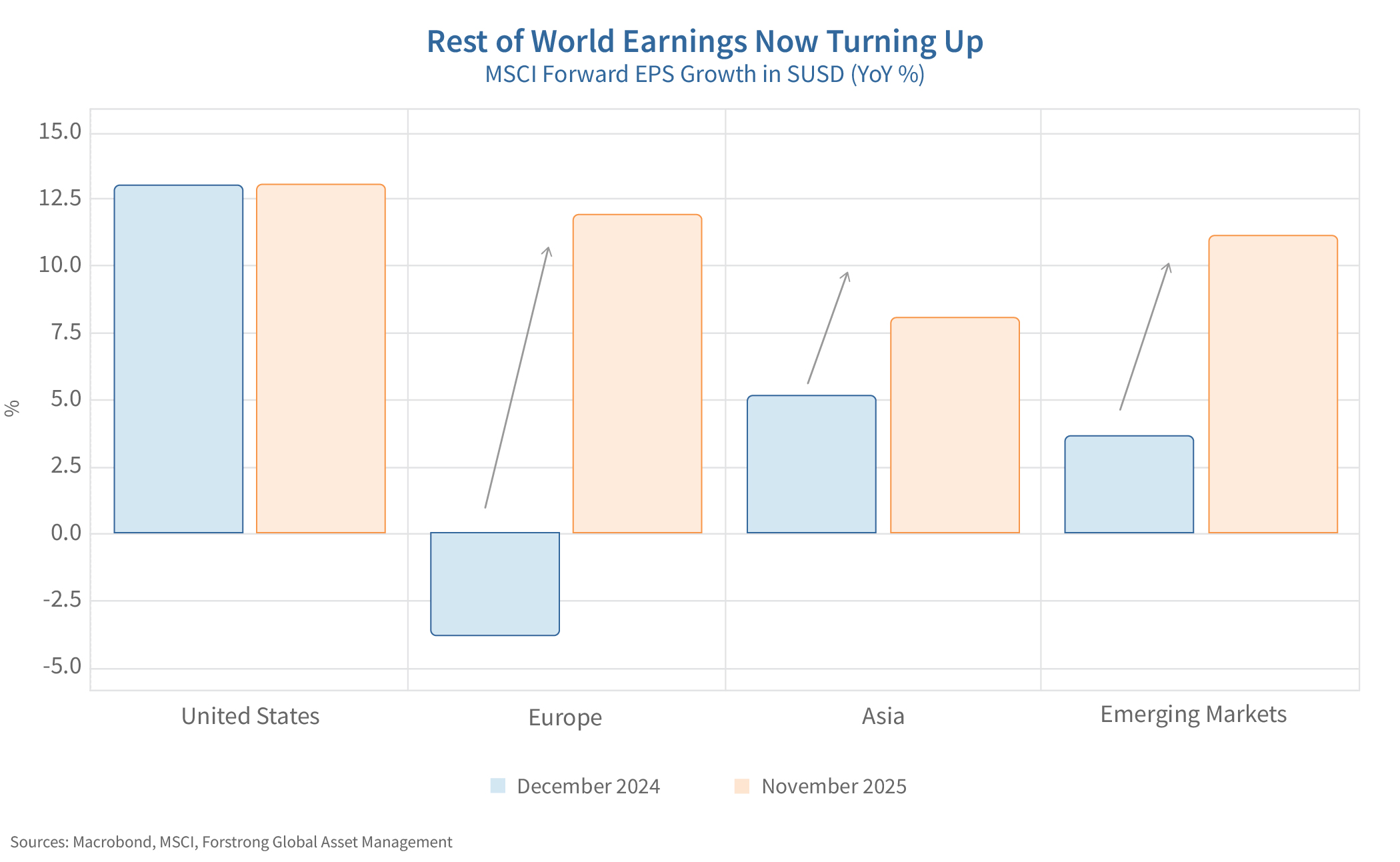
The strongest cyclical impulses in the global economy are now emerging outside the United States, with Europe reflating, Japan reforming and Asia regaining momentum. Commodity-linked emerging markets are also strengthening as external balances improve and the real economy revives. After years of being structurally underweight, global investors are confronting a long-overdue rotation toward the rest of the world.
Super Trend 2
Fiscal Firepower: The New Government Put
The post-pandemic world has ushered in a new era where fiscal policy, not monetary policy, anchors macro outcomes. Governments are deploying large-scale spending on infrastructure, industrial policy, defence and energy transition — creating both durable demand and unintended consequences. Investors must think beyond traditional business cycles and toward fiscal policy super-cycles.
Super Trend 3
The Adopters: AI’s Second Act
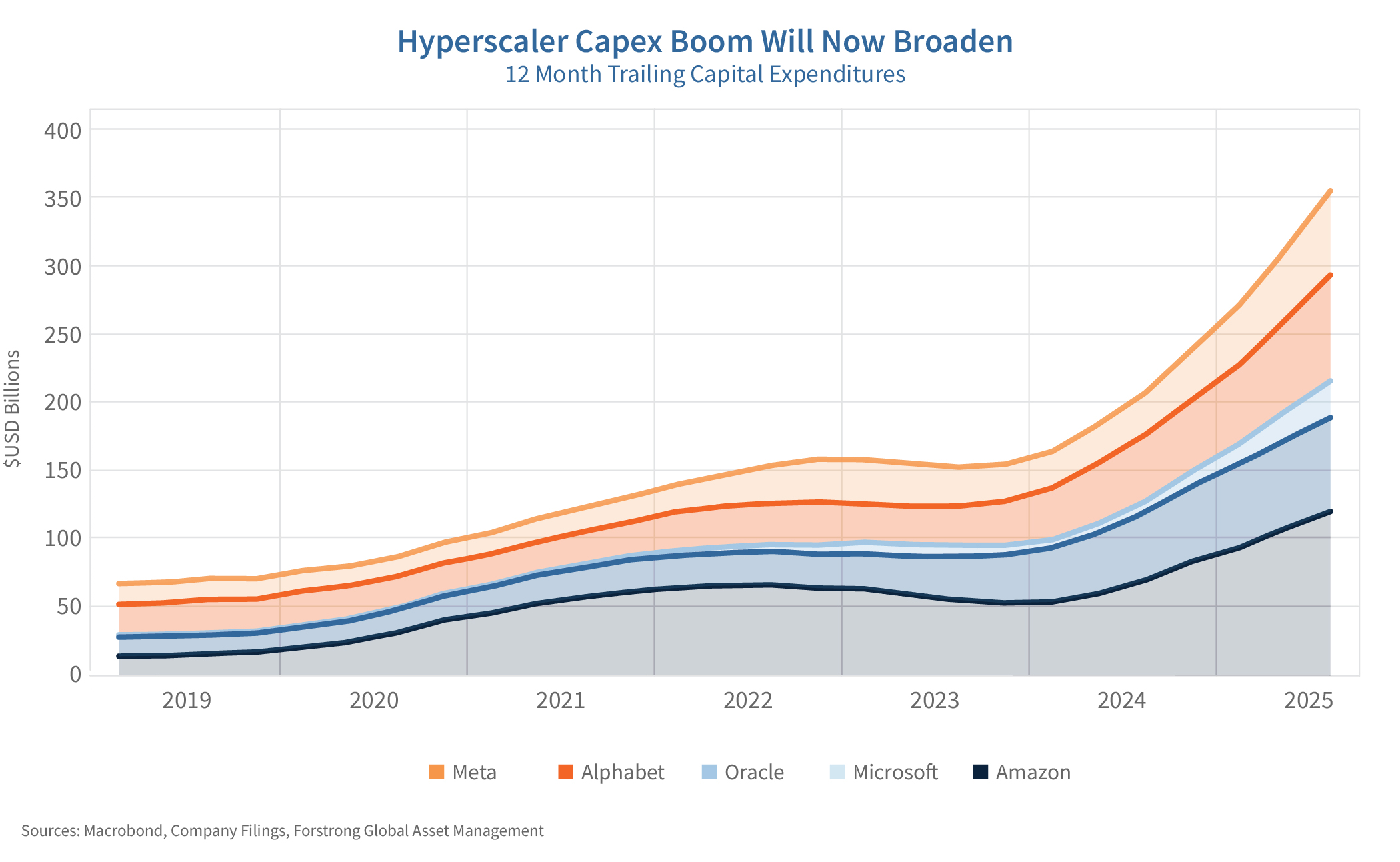
AI is transitioning from a narrow, mega-cap story to a broad-based investment cycle. Corporations are finally deploying capital into automation, robotics, data infrastructure and AI-enabled tools, setting up the first genuine productivity acceleration in decades. The new winners won’t just be chipmakers — they’ll be the adopters and enablers across healthcare, logistics, industrials, finance and the wider real economy.
Super Trend 4
Revenge Of The Real Economy
A global rebuilding boom is underway as countries reinvest in physical capacity — from infrastructure and energy systems to industrial supply chains and defence. Years of underinvestment have created structural tightness across critical materials, transportation and engineering capacity. Real assets and the income streams they generate are reclaiming a central role in diversified portfolios after a decade in the wilderness.
Super Trend 5
The Great Rebalance
Super Trend 6
Currency Cold War
Currencies are becoming active tools of statecraft as nations weaponize tariffs, capital-flow measures and tax policy to shift economic pressures abroad. This is accelerating reserve diversification, bilateral invoicing and the formation of regional currency blocs. The era of unchallenged US dollar supremacy is slowly giving way to a more fragmented currency order.
Super Trend 7
The Safe Haven Shakeup
The traditional hierarchy of safe havens is being rewritten. Many emerging markets now display stronger balance sheets, more credible central banks and healthier external accounts than their developed market counterparts — while the West faces swelling debt and political uncertainty. The paradox of the 2020s: resilience is emerging in places long overlooked, while risk increasingly hides inside the assets once assumed to be safest.
Super Trend 1
The Rise of the Rest
Japan, meanwhile, is in the middle of a genuine economic renaissance. Its policy regime is normalizing, corporate reforms are accelerating, and shareholder returns are improving after years of stagnation. Investors who had written off the world’s third-largest economy are now forced to reconsider its role in global portfolios.
Across Asia, the story is one of reacceleration. Supply chains are reorganizing into regional hubs, domestic demand is strengthening, and export cycles are firming. Even China, long dismissed as uninvestable, is shifting policy from damage control toward stabilization. While structural challenges remain, the country’s pivot toward targeted stimulus and more predictable policymaking has helped steady the economic floor.
Commodity-linked emerging markets are benefiting as well. Years of cautious fiscal policy, credible central banks and improving external balances have left many EM economies in far better shape than their developed market peers. Add in rising demand for metals, energy, transportation and engineering capacity, and the global growth map looks far more geographically balanced than at any point in the past decade.
In other words, a broad cast of regions that spent years lagging are now moving into leadership. This is not a temporary burst of activity but the early stages of a multi-year earnings cycle enabled by better policy foundations, healthier balance sheets and more competitive currencies.
After years of being structurally underweight, global investors are finally confronting a long-overdue rotation toward the rest of the world. Capital is beginning to flow toward Europe, Japan and EM Asia — a shift that is still in its early innings.
Investment Implications
-
Go Global: Increase exposure to non-US equities where earnings breadth is expanding.
-
Buy Reflation: Tilt toward cyclicals, financials, and resource producers in recovering economies.
-
Target Quality EM: Look for favorable macro trends in markets like India and Chile.
Super Trend 2
Fiscal Firepower: The New Government Put
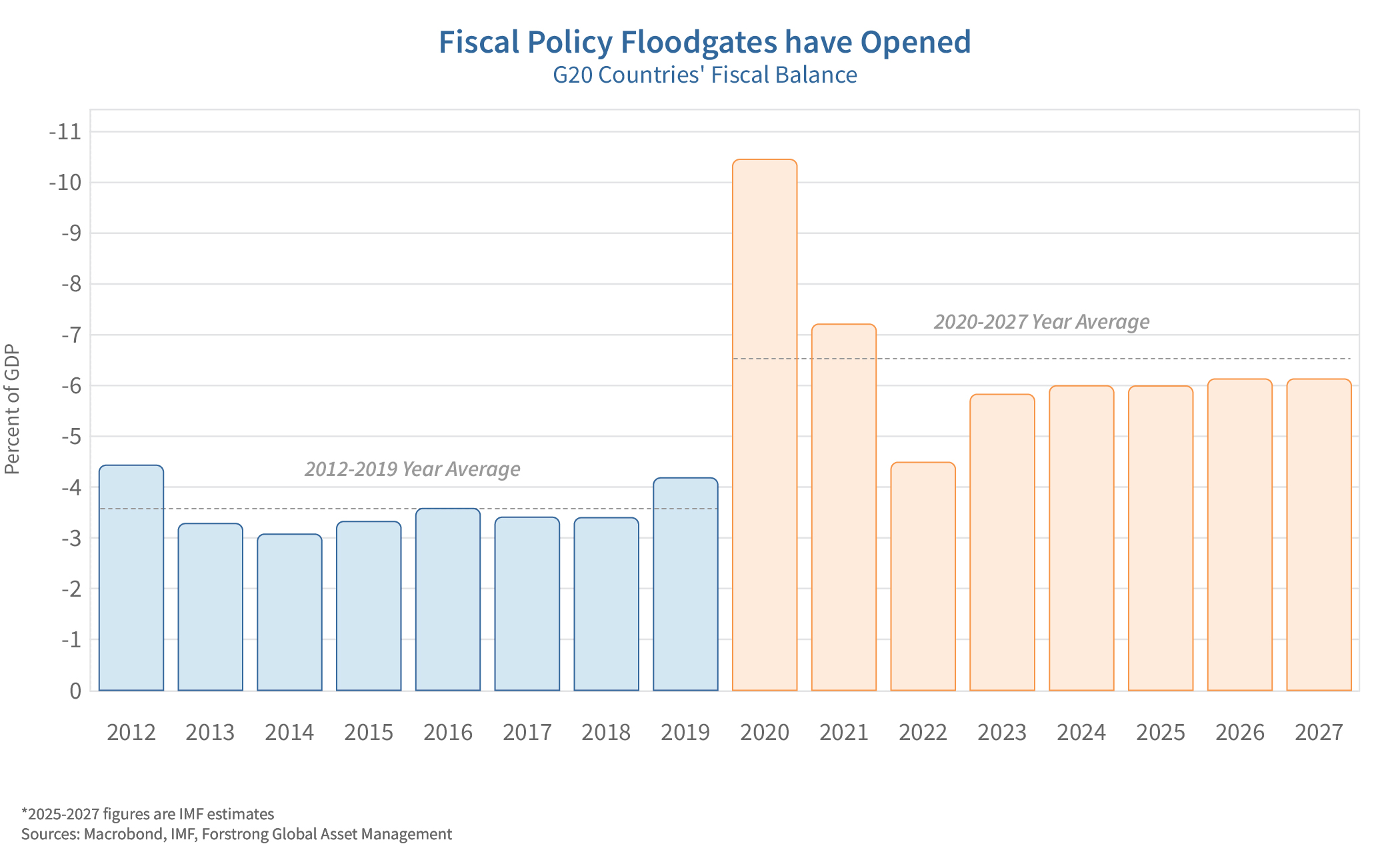
Fiscal policy is now the dominant driver of nominal growth. Governments are deploying unprecedented amounts of capital toward infrastructure renewal, energy transition, supply chain resilience and national industrial strategies. In the United States, Europe and Asia, the scale of public investment is reshaping entire sectors and setting the tone for multi-year economic cycles.
This shift removes many of the deflationary pressures that defined the 2010s. Instead of relying on ultra-low rates to coax demand forward, fiscal policy is creating new sources of spending and investment. The result is a world with stronger nominal GDP, more persistent inflationary pressures and broader corporate earnings cycles.
Equally important is the institutionalization of the government rescue reflex. Whether in banking stress, energy crises or geopolitical shocks, policymakers increasingly turn to fiscal support rather than interest rate cuts. Crises that once triggered long recessions now lead to targeted stimulus and faster recoveries.
For investors, this represents a profound regime change. The economic contours of the past decade — low growth, low inflation, low rates — are inconsistent with the fiscal-dominated world now taking shape. Public investment is creating durable demand, reshaping competitive dynamics and driving capital toward sectors aligned with government priorities.
The investment landscape that emerges from this will not look like the 2010s. It will be more cyclical, more inflationary and more conducive to real assets, industrials, infrastructure and companies tied to physical investment.
Investment Implications
-
Position for Higher Nominal Growth: The low-growth, low-inflation world is gone. Expect shorter, shallower downturns due to fiscal support.
-
Follow the Money: Favour real assets, industrials, and sectors aligned with public investment.
-
Avoid the Rate Trap: Underweight assets that need low interest rates to survive (including broad swaths of private markets). The 2010s are not coming back.
Super Trend 3
The Adopters: AI’s Second Act
Corporations are now deploying real capital into automation, robotics, workflow optimization, software tooling and data infrastructure upgrades. These are not speculative investments; they are productivity-driven initiatives designed to address labour shortages, rising wage costs and operational inefficiencies.
This shift is happening across sectors that historically lagged in digital adoption — healthcare networks optimizing diagnostic throughput, logistics firms reducing routing inefficiencies, industrial manufacturers automating low-value processes, and financial institutions modernizing risk and compliance workflows.
After a decade of sluggish productivity growth, the conditions for a genuine acceleration are finally taking shape.
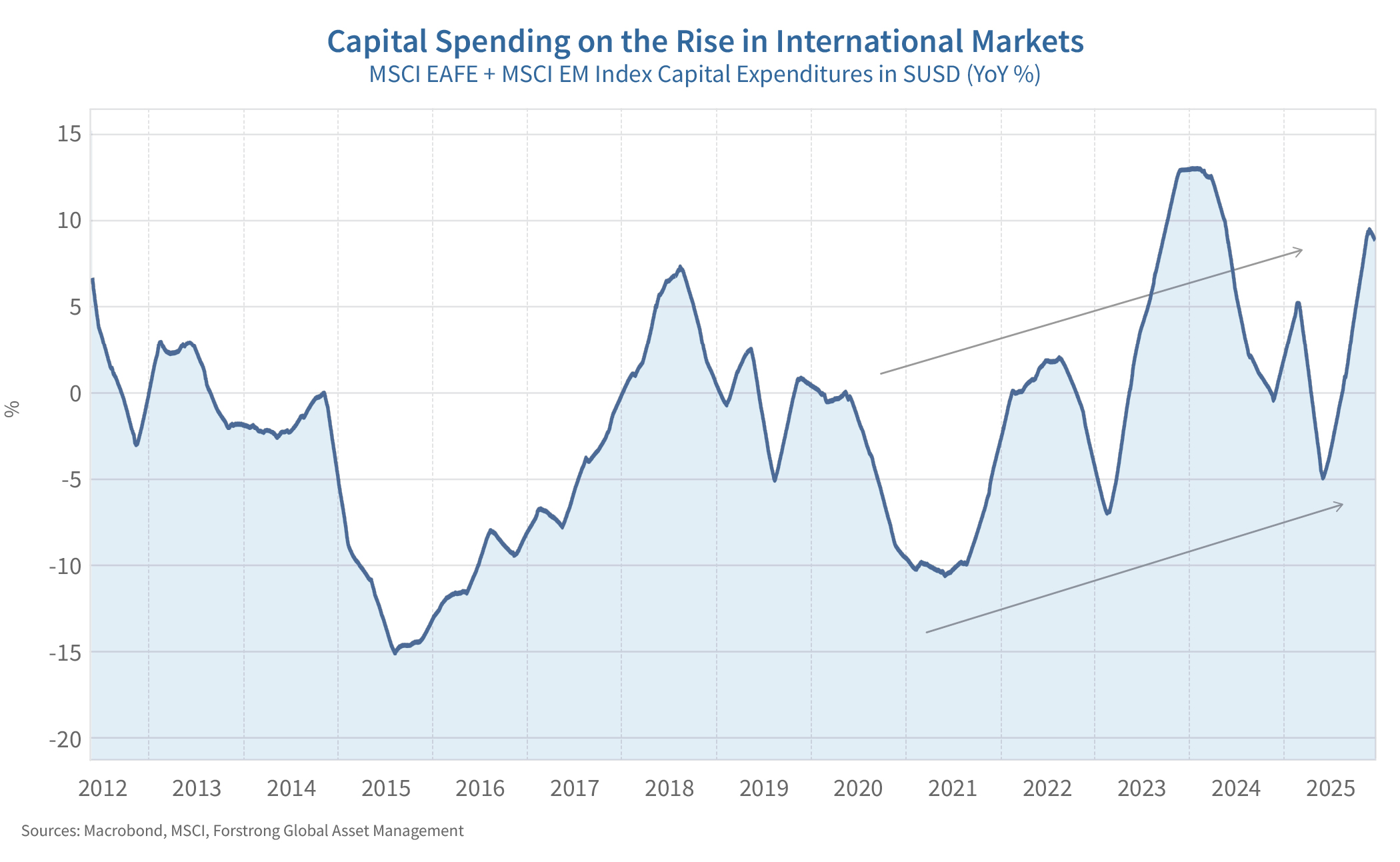
AI is moving from promise to application, from hype to measurable economic impact. Capital expenditure linked to AI is now broadening across regions as well — Japan, Korea and Taiwan are investing heavily in digital infrastructure and automation capabilities.
The winners of this era will not only be chipmakers and hyperscalers. They will be the companies that adopt AI effectively, embed it into their operations and amplify human productivity. These “enablers and adopters” will define the next phase of the cycle.
As AI’s second act unfolds, its contribution to global growth will become more tangible — not through valuation multiples, but through real world productivity improvements.
Investment Implications
-
Look Beyond the Magnificents: Broaden exposure to the “users” of AI in healthcare, logistics, and industrials
-
Buy the Global Picks and Shovels: Increase exposure to countries building digital infrastructure (Japan, Korea, Taiwan).
Super Trend 4
Revenge of the Real Economy
Governments are now directing enormous amounts of capital toward energy systems, transport networks, grid infrastructure, manufacturing capacity and engineering capabilities.
The pandemic shattered the austerity reflex and created political space for ambitious fiscal programs that prioritize resilience over cost-minimization.
This renewed focus on the real economy is reversing many of the deflationary impulses that defined the 2010s. As fiscal firepower meets rising industrial demand, capacity constraints are emerging in everything from metals to shipping to specialized labour. These bottlenecks are not temporary — they are features of a world reinvesting in itself after a long period of neglect.
For investors, this represents a clear regime change. Real assets, commodities, infrastructure and income-producing sectors are regaining their central place in diversified portfolios. Physical investment cycles tend to be long-lived, supply-intensive and globally coordinated — the exact opposite of the intangible-driven tech surges that dominated the previous decade.
This multi-year capex boom extends well beyond AI and into the material foundations of the global economy. It is the most significant reallocation of capital toward real-economy assets since the postwar period.
Investment Implications
-
Own Atoms: Increase exposure to commodities, infrastructure, and real-asset equities benefiting from capex cycles
-
Play the Bottlenecks: Position for tighter supply in key metals essential to electrification (e.g. copper).
-
Hedge with Real Assets: Use them to protect against sticky inflation and geopolitical volatility.
Super Trend 5
The Great Rebalance
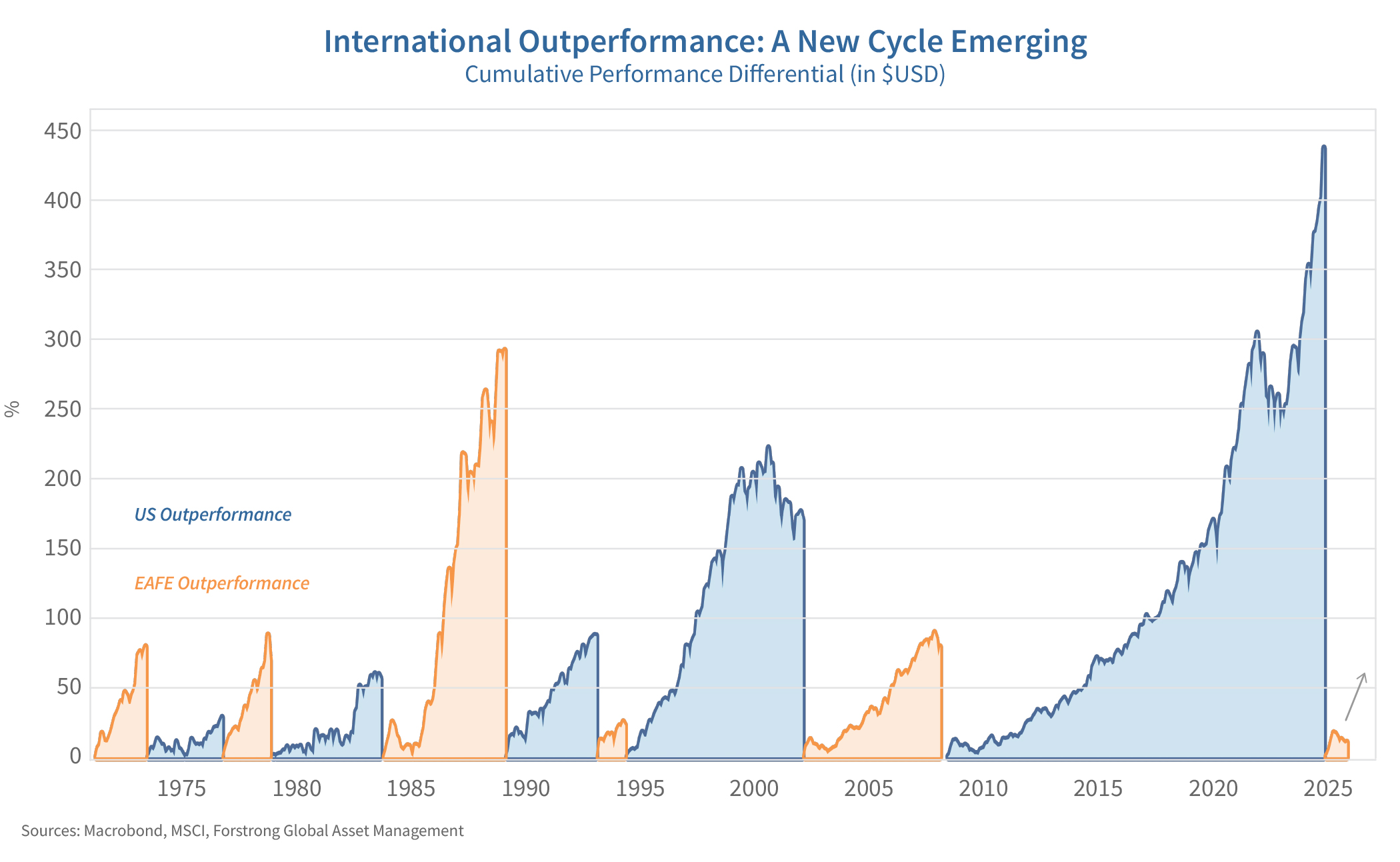
This shift is not merely a tactical rotation; it is the foundation of the next market cycle.
The sectors positioned to lead — value, cyclicals, financials, industrials, resource producers — have spent years under-owned and undervalued. As the global economy becomes more balanced and geographically diversified, market leadership will reflect that balance.
Earnings cycles across Europe and Japan are strengthening, supported by currency competitiveness, healthier corporate governance and improving domestic demand. EM Asia is benefiting from regional supply chain integration, rising consumption and favourable policy settings.
The next bull market is unlikely to look anything like the last one. It will be more globally distributed, less concentrated in narrow tech leadership, and driven by a world where multiple regions contribute to growth simultaneously.
Investors anchored to the past decade’s winners may miss one of the most important turning points of the 2020s. Global diversification is again becoming a return driver — not just a risk management tool.
Investment Implications
-
Cut Concentration Risk: Reduce US equity exposure. Leadership is moving elsewhere.
-
Buy Value: Tilt toward cyclicals and financials where valuations and earnings are improving.
-
Rebalance: Increase allocations to Europe, Japan and EM as part of a more globally distributed bull market.
Super Trend 6
Currency Cold War
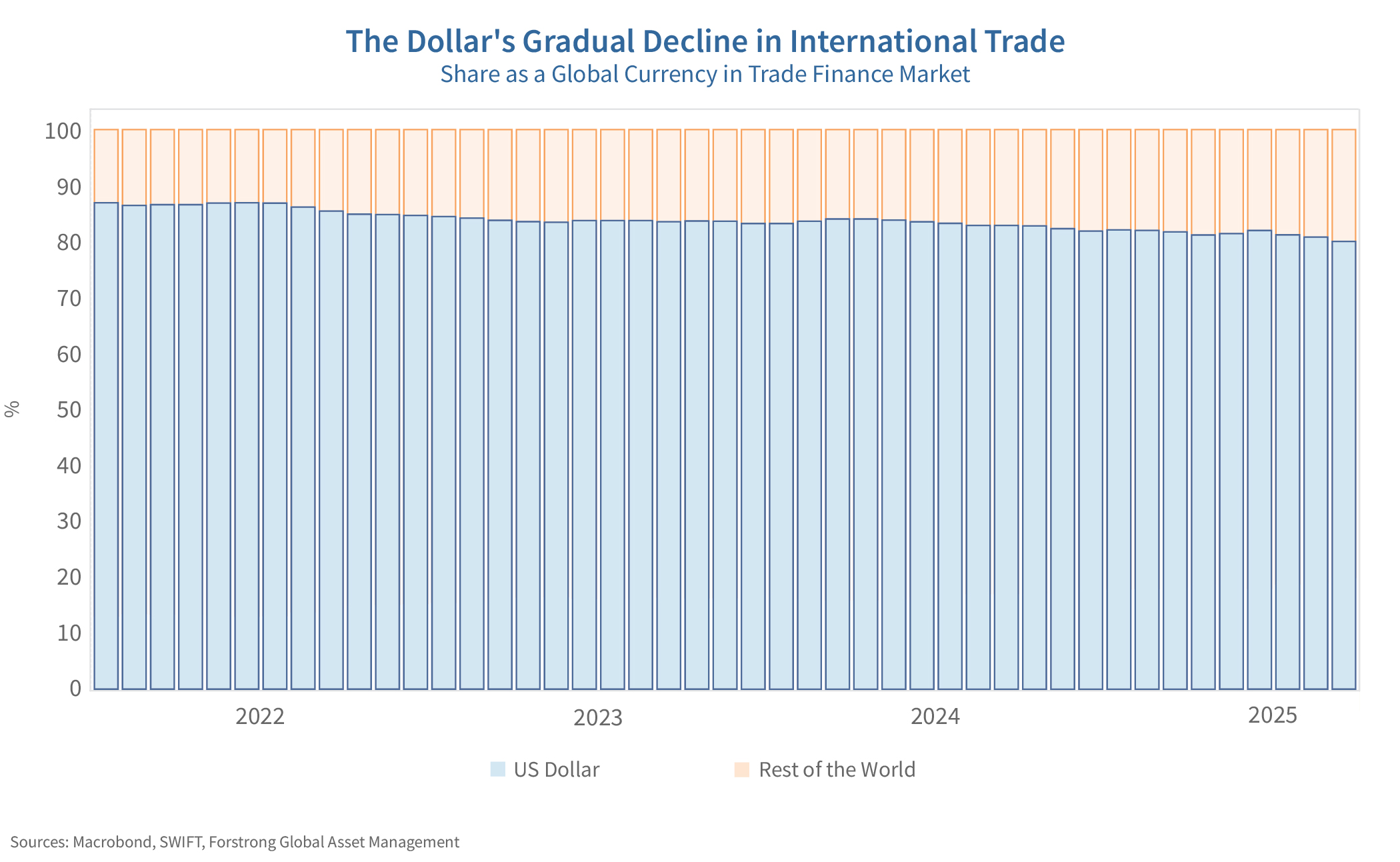
In response, countries across Asia, the Middle East and Latin America are exploring alternatives. Bilateral trade settlements are rising, regional currency blocs are emerging, and reserve diversification is accelerating. While the US dollar remains dominant, its supremacy is becoming more contested.
This shift is changing how currency cycles work. Historically, dollar strength or weakness could be explained largely through interest rate differentials or growth spreads. Today, geopolitics, sanctions risk, trade fragmentation and national-security considerations are equally important.
For investors, currency exposure has become an active source of return as well as a hedge against policy divergence. EM currencies with improving fundamentals, credible central banks and healthier external accounts offer opportunities not seen in years.
The currency landscape is fragmenting — and with it, the assumptions that underpinned the last 30 years of global finance.
Investment Implications
-
Active FX: Treat currency exposure as a return driver, not just a risk factor.
-
Look to EM: Selectively add exposure to EM currencies with strong fundamentals.
-
Watch the Geopolitics: Dollar cycles now reflect foreign policy as much as Fed policy.
Super Trend 7
The Safe Haven Shakeup
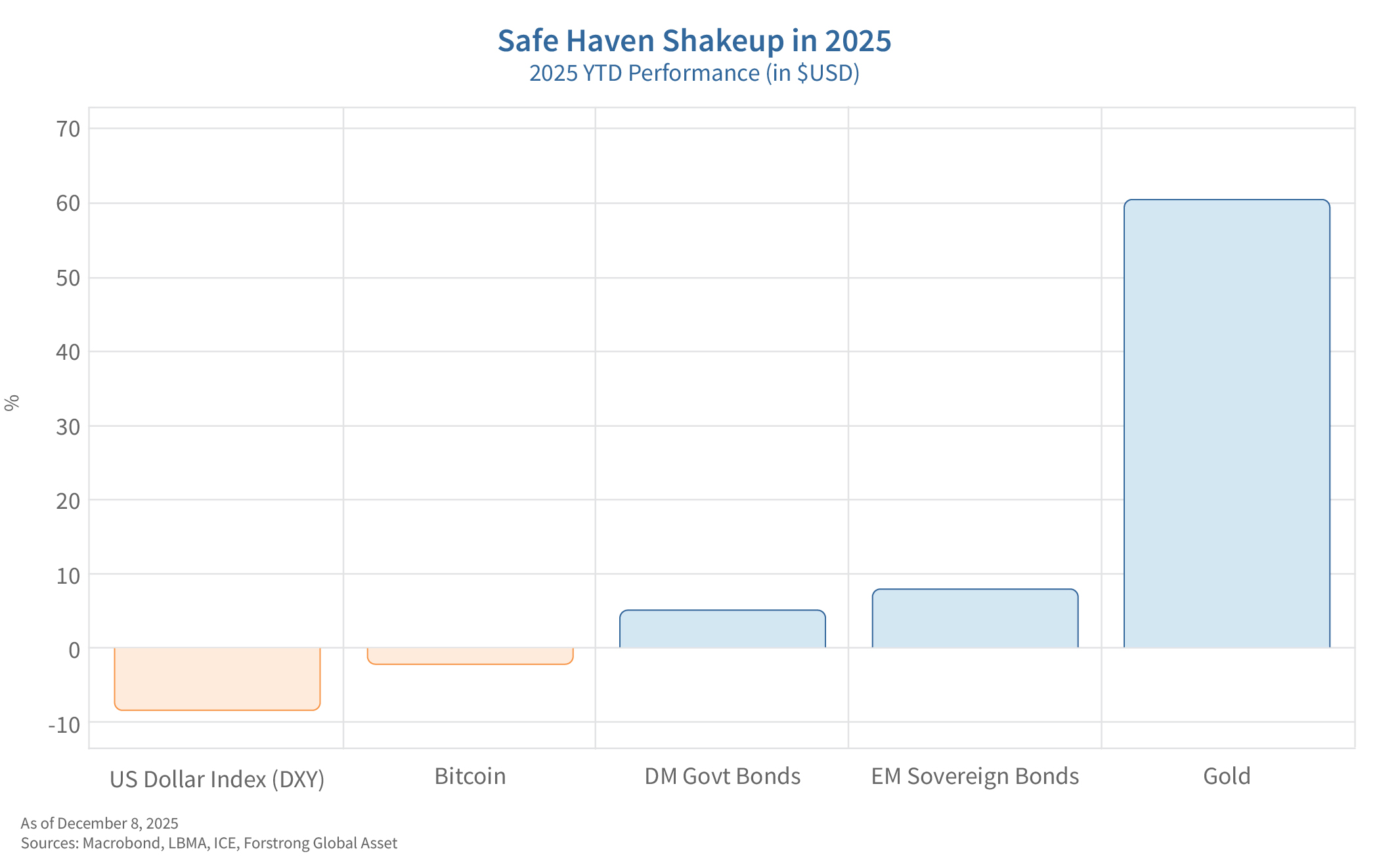
This challenges the oldest rule in the book: “Buy Western bonds for safety.” G7 government bonds and reserve currency assets can no longer be considered universally safe. Risks that were once neatly categorized by geography or income level are now far more dispersed. Resilience is emerging in unexpected places; vulnerability is appearing in old strongholds.
A striking divergence is also emerging in alternative stores of value. Crypto thrives on speculation — a liquidity-sensitive, high-beta expression of tech sentiment. Gold thrives on uncertainty — slow, steady and historically reliable when policy appears unmoored. As monetary anchors weaken and geopolitical risks rise, gold’s role as an alternative currency and portfolio hedge is growing.
In a Split-Screen World, even safety must be redefined. The question is no longer “Is this market developed or emerging?” but “Is this balance sheet credible, is this policy framework stable, and is this asset insulated from political risk?”
The new safe-haven landscape requires a far more nuanced, global approach.
Investment Implications
-
Rethink Safety: Diversify beyond traditional G7 bonds.
-
Go where the Quality is: Add high quality EM debt where balance sheets are strong.
-
Own the Anchor: Maintain gold exposure as a hedge against policy chaos.
The 2026 Playbook
Quick Reference Guide

The Macro Lens:
Connecting Portfolios to a Changing World
What follows is the connective tissue between worldview and action — how we translate global forces into positioning, how we turn signals into structure, and how we build portfolios that stay aligned with the world as it unfolds rather than the world investors remember.
This is the shift from seeing the map to navigating it.
Key Takeaways
- The “autopilot” era is over. The stability of the last two decades has given way to structural divergence. Static asset mixes no longer suffice.
- The missing link. Portfolios often contain strong distinct pieces—stock picks, managers, alts—but lack the strategic overlay to connect them.
- Clarity, not forecasting. Macro is not about guessing markets. It is a disciplined framework that brings coherence to a “split-screen” world.
- Your strategic defense. In a world of fiscal activism and inflation, macro provides the adaptive defense necessary to preserve capital.
For decades, he was right. We lived in a world of stable institutions, predictable inflation, and prolonged US dominance. A simple North American mix plus bonds worked on autopilot.
That era is long over. The drivers of returns are fragmenting. A new regime of structural divergence is underway.
Most portfolios today contain excellent building blocks. Whether you hold high-conviction single stocks, core ETF positions, trusted third-party managers, or private market allocations, the individual components are often strong.
However, in this new era of fiscal activism and structural inflation, macro is not optional. It is the organizing framework that brings coherence and intention to modern capital.
1. What Macro Actually Is
Macro is often mistaken for dramatic calls or market timing. It is neither.
Instead, macro is a disciplined framework for understanding the structural forces that define returns. It is a strategic, ongoing input that complements, rather than competes with, security selection.
Our top-down approach is defined by three questions:
1. Where are we in the global cycle? This is a reading of the operating environment: How are growth, inflation, and policy evolving? This establishes the current backdrop for every security and region.
2. Which assets align with that backdrop? Macro identifies where the tailwinds are strongest—across regions, sectors, and asset classes—based on prevailing forces like fiscal activity or currency dynamics.
3. How do we combine exposures? The goal is not a single winner. It is to build a mix of exposures that remain resilient across multiple paths. We prepare for different regimes rather than guessing outcomes.
2. Why Macro Matters in a “Split Screen” World
Clients see a world defined by tension and contradiction. A macro lens resolves that tension:
What Clients See
Global Markets: The US feels unstoppable, yet Japan, Europe and Asia are hitting highs. Clients wonder if they are missing out.
What Macro Explains
Leadership is broadening because the global cycle is shifting. Valuations and policy favour non-US markets. This is normal as cycles mature.
What Clients See
Policy: Governments spend aggressively on infrastructure while central banks cut rates. Clients see mixed signals.
What Macro Explains
Fiscal policy now drives the cycle. Countries investing heavily in physical and digital infrastructure are reshaping where long-term growth will occur.
What Clients See
Assets: AI dominates headlines, yet real-world sectors like metals and manufacturing are surging.
What Macro Explains
The real economy is reasserting itself. AI needs energy, copper, and grids to scale. This is why “old-economy” assets are outperforming again.
What Clients See
Inflation: Price increases are slowing but not disappearing. Clients are unsure whether to play defense or take risk.
What Macro Explains
We are in a new regime. A moderate-inflation, higher-volatility world favours diversified portfolios that include commodity exposure and active currency management.
What Clients See
Geopolitics: Tensions feel higher than ever. Clients fear sudden market shocks.
What Macro Explains
Geopolitics affects capital flows. A global portfolio reduces exposure to single-country shocks and captures opportunities created by regional realignments.
What Clients See
Global Markets: The US feels unstoppable, yet Japan, Europe and Asia are hitting highs. Clients wonder if they are missing out.
What Macro Explains
Leadership is broadening because the global cycle is shifting. Valuations and policy favour non-US markets. This is normal as cycles mature.
3. From Worldview to Portfolio: How Macro Shows Up in Practice
In the Forstrong process, macro is not an abstract note. It dictates concrete, globally-aware choices.
Targeting Global Leadership (Example: Chile)
The thesis starts with the structural need for global electrification. Instead of only buying pure producers, we identified Chile. As the world’s largest copper producer and a major lithium source, this single country provided access to both metals just as its broader fundamentals improved. The investment aligns a global trend with a specific regional opportunity.
Reading Regional Signals (Example: Sweden)
We use certain national markets as early indicators. Sweden is deeply linked to global manufacturing. When industrial momentum shifts, Sweden often reflects that change early. This insight gives us an advantage in European equity and currency positioning.
Translating Conditions into Income (Examples: Italy & Singapore)
We look for income created by structural shifts, not just yield. Italy benefits from improving fiscal dynamics that support its banks and utilities. Singapore benefits from strong governance and an economy leveraged to resilient Asian trade.
Using Real Assets as a Structural Hedge (Example: Gold & Energy)
In a world of shifting monetary anchors, real assets are essential tools. Gold acts as an antifragile asset when policy stress rises. Energy exposure is critical when supply constraints drive structural inflation. These are dynamic tools applied when the current regime dictates their relevance.
4. How Macro Fits into Your Portfolio
We understand that most advisors are not starting from scratch. You already have a process—whether that involves stock picking, fund selection, or model building.
The Forstrong macro lens provides the strategic overlay that brings these pieces together. Our core mandates serve three essential functions for your overall investment capital:
1. True Diversification: We broaden the opportunity set. True diversification extends beyond simple asset allocation to align capital with the major forces driving the global economy. This protects portfolios from reliance on any single region or outcome.
2. Active Opportunity: We capture shifting leadership. Global growth is dynamic, not static. We move capital strategically toward emerging growth centers and undervalued markets, positioning portfolios to benefit from change rather than chasing the past.
3. Adaptive Defense: We manage regime risk. Economic climates eventually shift. We actively adjust the asset mix across equities, fixed income, and real assets to preserve capital when environments change and volatility rises.
The objective is simple and powerful: We help deliver portfolios that feel coherent and connected to the world you read about every day.
Our Strategies:
Clarity in a Chaotic World
Key Takeaways
- Start with the whole world. We reject home bias. We view the entire globe as our opportunity set, allowing portfolios to move fluently with capital currents.
- Resilience over prediction. We do not guess the future. We build for clarity and adaptability, avoiding the trap of reacting to headlines.
- Three paths, one philosophy. Our strategies offer distinct risk profiles, but share a single mission: to navigate structural change with discipline.
At the time, China was joining the global economy. The Euro was unifying Europe. Commodity markets were waking up. You could sense history turning even if you could not yet draw the lines. Our founders concluded that if the world moves like this, portfolios need to move with it.
That perspective was rare then. It remains rare today.
Most portfolios are anchored to one country or one static worldview. We built something different: a framework that is fluid, globally aware, and adaptable. We do not offer forecasts. We offer a disciplined way to navigate global shifts. We stay calm when the world moves sideways and adapt when new leadership emerges.
Three principles define how we invest:
1. We start with the whole world
The global economy is too interconnected to rely on one region. Beginning with a global mandate gives us a broader canvas. It creates more opportunity and leaves fewer blind spots.
2. We move with the currents
Global conditions tilt and turn. Policy shifts ripple outward. Liquidity rises and retreats. We allow our positioning to adjust with these structural changes. This keeps portfolios aligned with the world unfolding ahead, not the cycle that has already passed.
3. We use the best tools available
We search the entire ETF universe with purpose. Nothing enters the portfolios out of habit. Some holdings drive opportunity. Others soften shocks. Together they create a balanced, precise expression of the global landscape.
The Result: A Different Kind of Portfolio
- Static balanced ETFs do not adapt to regime changes.
- DIY global portfolios often depend on instincts and timing.
- Bottom-up stock picking is valuable for analyzing businesses but often misses the larger forces that move entire regions and currencies.
Our Strategies:
The Mandates

Forstrong Global Income
Income stability on a global foundation
A globally diversified income engine. We look beyond domestic borders to find countries where real yields, policy cycles, and currency trends create the most favorable conditions. We build the mix using bonds, dividend-oriented equities, and selective real assets. The goal is steady income with thoughtful capital preservation.
The Role in a Portfolio
A global anchor. This is for investors who want income that is not tied to any one economy or yield curve, while maintaining a risk profile similar to a bond fund.

Forstrong Global Balanced
The world in one portfolio
The core expression of the Forstrong philosophy. This is a flexible blend of global equities, bonds, real assets, currencies, and cash. The mix evolves as global leadership rotates and cycles diverge across regions. It is built to capture opportunity where it emerges while keeping a clear focus on risk management.
The Role in a Portfolio
A core holding. This is for investors who want a single, risk-managed, globally aware solution to anchor their financial plan.

Forstrong Global Growth
Equity leadership chosen with a global eye
A wide-angle equity strategy. We seek growth where global conditions are strongest rather than where momentum was last cycle. We combine regional earnings trends, valuation signals, and currency dynamics with selective real asset exposures to sharpen the risk-reward profile.
The Role in a Portfolio
A global growth engine. This is for long-horizon investors who want broad opportunity without losing sight of structural risk.
About Our Investment Team
Diverse By Design
At Forstrong, we build teams the same way we build portfolios, by combining different strengths rather than relying on a single viewpoint. Our investment team brings together professionals of different ages, backgrounds, experiences and cultural perspectives. These differences are intentional. They give every discussion more depth and every decision a wider base of evidence.
Our process reflects this structure. The team meets frequently to review global signals, challenge assumptions and refine the firm’s macro views. Each member contributes a distinct lens. Some focus on sentiment and the big picture. Some bring fundamentals and detail. Others concentrate on trading, flows and market structure. Together, these perspectives create a balance that no single discipline can achieve on its own.
This is how our strategies are formed: through steady discussion, careful reconciliation of competing views and clear preference for decisions that hold up across different scenarios. It is a process that keeps us anchored in reality rather than ideology and helps shape portfolios that are genuinely built for what is next.
How our team is structured:
Forstrong’s investment team works as a single integrated unit with two formal forums.
The Portfolio Management Team leads daily portfolio design and implementation, while the Investment Committee brings the same professionals together with our senior advising members to test ideas, challenge assumptions and set long term direction. The structure is complementary. It ensures that decisions benefit from both constant attention and periodic wide-angle review.
Portfolio Management Team
Responsible for ongoing portfolio construction, positioning and risk management under the leadership of our Chief Investment Officer.
Investment Committee
A broader decision forum that includes the Portfolio Management Team and our senior advising members. Its role is to identify major macro themes, refine long term strategy and provide oversight to the day to day process.
The people behind the process:
Portfolio Management

Tyler Mordy
CEO & CIO

David Kletz
Lead Portfolio Manager

Karen Tsang
Portfolio Manager, Head of Trading & Investment Operations

Shibo Gu
Research Analyst

Andrew Gapski
Investment Fund Operations Analyst
Advising Members

Wilfred Hahn
Global Investment Strategist, Advising Member of the Investment Committee
Terence Shaunessy
CIO, Forstrong Private Wealth, Advising Member of the Investment Committee
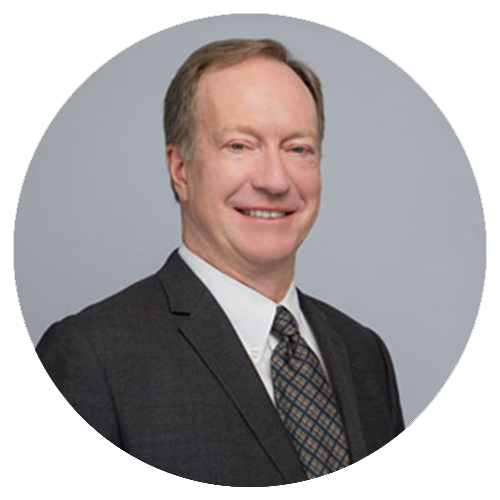
Mark Arthur
Global Investment Strategist, Advising Member of the Investment Committee
Nothing herein is or shall be deemed to constitute investment, research, tax, financial, or legal advice, nor an opinion or recommendation regarding any products, strategies, or any security in particular or the appropriateness of any investment. Nothing contained in these materials is, or should be construed or used as, an offer, a solicitation of an offer, or an invitation to buy or sell any security, investment, fund, or financial product or instrument, or an endorsement, recommendation, or sponsorship of any entity or security cited or to adopt any particular investment or portfolio strategy. This material contains general information only and does not have regard to the specific investment objectives, financial situation, risk profile, or the particular needs of any specific person who may receive these materials. These materials are not intended for distribution in any jurisdiction where such distribution would be contrary to law. It is your responsibility to inform yourself of, and to observe, all applicable laws and regulations of your relevant jurisdiction. Unless we provide express prior written consent, no part of these materials should be reproduced, distributed, or communicated to anyone else. The information herein does not provide a sufficient basis for an investment decision and Forstrong Global Asset Management Inc. (“Forstrong”) makes no representation as to the suitability of any investment described herein. Investors should assess as to whether the information is appropriate in their individual circumstances and should consult with their own investment, tax, financial, and legal advisors before making any investment decisions. Investors should also carefully consider any risks involved. Forstrong does not hold itself out to be an advisor in these circumstances, nor do any of its representatives have the authority to do so. Unless otherwise indicated, all monetary figures are expressed in Canadian dollars. Investing involves risk, including possible loss of principal.
The information contained in these materials is for general informational purposes only and is intended to provide only brief comments on broad market, industry or sector trends, or other general economic or market conditions. It is not intended to provide an overview of the terms applicable to any products or funds managed or sponsored by Forstrong. Views expressed regarding a particular company, security, industry, investment, or market sector are the views only of that individual as of the time expressed and do not necessarily represent the views of Forstrong or any other person in the Forstrong organization. These materials contain information and views as of the date indicated and such information and views are subject to change at any time without notice, based upon market and other conditions, and Forstrong disclaims any and all responsibility to update such information and views. These views are not and may not be relied upon as investment advice and, because investment decisions for a Forstrong fund or product are based on numerous factors, are not and should not be relied upon as an indication of trading intent on behalf of any Forstrong fund or product. Any opinion or assumption may contain elements of subjective judgment and are not intended to imply, nor should be interpreted as conveying, any form of guarantee or assurance by Forstrong of any future action or performance. Neither Forstrong nor any of its affiliates, businesses, or representatives make any representation or warranty, express or implied, as to the accuracy, reliability, completeness, appropriateness, or sufficiency for any purpose of any information contained herein. Forstrong and its affiliates and related entities disclaim any and all liability relating to the information herein, including, without limitation, any express or implied representations or warranties for, statements contained in, and omissions from, the information. Forstrong and its affiliates and related entities are not liable for any errors or omissions in any information herein or for any loss or damage suffered, whether direct or consequential, resulting from the use of these materials.
The information contained in these materials is strictly for general illustrative, educational, or informational purposes, and is not intended to provide legal, investment, accounting, or tax advice, and should not be relied upon in that regard. These materials contain information and views as of the date indicated and such information and views are subject to change at any time without notice, based upon market and other conditions, and Forstrong disclaims any and all responsibility to update such information and views. These views are not and may not be relied upon as investment advice. Any opinion or assumption may contain elements of subjective judgment and are not intended to imply, nor should be interpreted as conveying, any form of guarantee or assurance by Forstrong of any future action or performance. Neither Forstrong nor any of its affiliates, businesses, or representatives make any representation or warranty, express or implied, as to the accuracy, reliability, completeness, appropriateness, or sufficiency for any purpose of any information contained herein. Forstrong and its affiliates and related entities disclaim any and all liability relating to the information herein, including, without limitation, any express or implied representations or warranties for, statements contained in, and omissions from, the information. Forstrong and its affiliates and related entities are not liable for any errors or omissions in any information herein or for any loss or damage suffered, whether direct or consequential, resulting from the use of these materials.
Any specific companies, issuers, funds, ETFs, or indices mentioned are for illustrative or educational purposes only and are not and shall not be deemed to be a recommendation to buy or sell any securities. Any companies, issuers, funds, or ETFs mentioned do not necessarily represent current or future holdings of any Forstrong funds or products. Any strategies discussed are strictly for illustrative and educational purposes and are not a recommendation, offer, or solicitation to buy or sell any securities or to adopt any investment strategy. There is no guarantee that any strategies discussed will be effective.
Commissions, fees, and expenses may be associated with investments in Forstrong funds, ETFs, and/or other investment products. Please read a fund’s offering memorandum or ETF’s prospectus, as applicable, which contains detailed information, and speak to an advisor before investing. Funds and ETFs are not guaranteed, their values change frequently, and investors may experience a gain or loss. Past performance may not be repeated.
Certain statements in these materials may contain forward-looking statements or forward-looking information that are predictive in nature and may include words such as “expects”, “anticipates”, “intends”, “plans”, believes”, “estimates”, and similar forward-looking expressions or negative versions thereof. Such forward-looking statements are based on current expectations and projections about future general economic, political, and other relevant market factors, such as interest, and assuming no changes to applicable tax or other laws or regulations. Expectations and projections about future events are inherently subject to, among other things, risks and uncertainties, some of which may be unforeseeable and, accordingly, may prove to be incorrect at a future date. Forward-looking statements are not guarantees of future performance, and actual events could differ materially from those expressed or implied in any forward-looking statements. A number of important factors can contribute to these differences, including, but not limited to, general economic, political, and market factors in Canada and internationally, interest and foreign exchange rates, global equity and capital markets, business competition, and catastrophic events. You should avoid placing any undue reliance on forward-looking statements. Past performance is no indicator of future performance and the materials are not intended to forecast or predict future events. Forstrong disclaims any and all responsibility to update any forward-looking statements, whether as a result of new information, future events, or otherwise, except as specifically required by law.
The index returns are shown for illustrative or informational purposes only. Indexes are unmanaged, and index performance does not include the impact of fees, commissions, and transaction costs and expenses that would be payable by investors in investment products that seek to track an index. Such costs would lower performance. It is not possible to invest directly in an index. Past performance does not guarantee future results. Index performance does not represent actual fund performance.
The information contained herein is presented solely for illustrative purposes and should not be construed as a forecast or projection. While some information used herein has been obtained from various published and unpublished third-party sources considered to be reliable, such information has not been independently verified by Forstrong (and Forstrong disclaims any obligation to verify) and Forstrong does not guarantee its accuracy or completeness and accepts no liability for any loss or damage suffered, whether direct or consequential, resulting from its use. It should be noted that data provided may be approximate numbers.
Forstrong Global® and the Forstrong Global® logo are trademarks or registered trademarks of Forstrong Global Asset Management Inc. in Canada.
© 2025 Forstrong Global Asset Management Inc. All rights reserved.