
Ask Forstrong
Bessent Intentions:
The 5% Bond Yield Puzzle
September 2026
Ask Forstrong: Why aren’t 5% bond yields killing the bull market?
Key Takeaways
- A 5% 10-Year US Treasury yield isn’t necessarily a crisis. Stronger nominal growth and booming profits help explain why stocks are thriving alongside higher yields.
- Watch the signals, not the number. Markets, inconveniently, rarely respect round numbers. Falling earnings and widening credit spreads would worry us far more than any arbitrary yield threshold.
- Invest for the 5% world. Favour cash flows, shorter-duration bonds, real assets, select emerging markets and the broadening equity rally.
Welcome back to the school year, dear readers. We continue to be impressed by the questions you send our way. Please keep them coming. But today, we’re turning the tables and have a question for you: is this the most resilient bull market ever? Consider the headwinds: stubborn inflation, renewed tariff threats, oil above $100, a growing collection of hot wars around the world and, at this point, why not throw in the Year of the Horse, Mercury in retrograde and whatever else is menacing your portfolio.
And, yet, what’s this? Stock markets keep marching higher. The Dow just hit another record. Bank stocks are breaking out. Within equities the strongest regional flows are heading toward emerging markets, while investors are rotating out of defensives into cyclical sectors. And—avert your eyes—even European stocks are soaring.
This is not exactly the picture of a market buckling under the weight of bad news. But of all the things that could go wrong, the bond market matters most. Higher interest rates have been present at the scene of most macroeconomic crimes over the years, from recessions to bear markets to financial accidents.
And while some of us spent the summer diligently monitoring global financial conditions from various patios, beaches and airport lounges, government bonds went through the mincing machine. The benchmark 10-year US Treasury yield crossed 5% this week, revisiting a level briefly breached during the bond market selloff of 2023 but otherwise unseen since 2007. Further out the curve, the 30-year yield is already well above 5%, back around levels last seen before the global financial crisis.
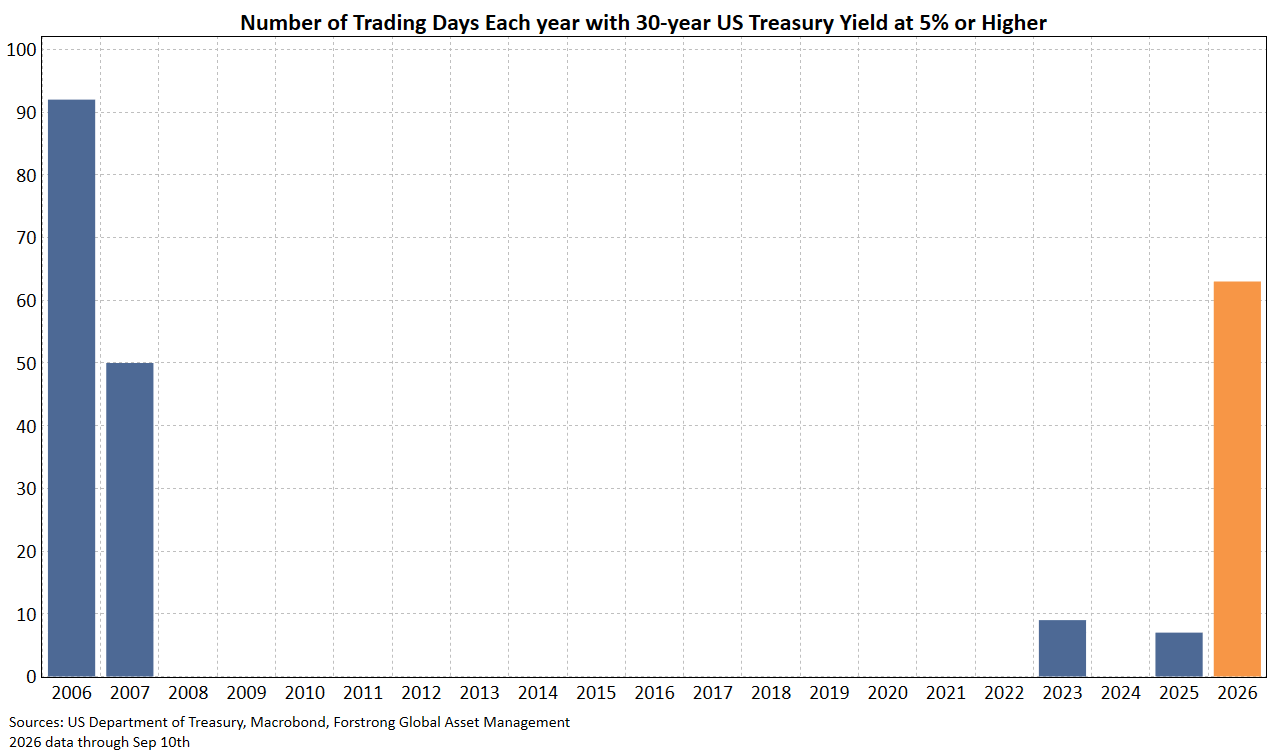
Much ink has been spilled over what comes next. Brace for the coming “great repression,” warns the IMF. Last week, Norway’s $2.3 trillion sovereign wealth fund said it would cut the weight of government debt in its bond portfolio from 70% to 50%. And those perennial optimists in the precious-metals sector think we should just short bonds altogether (to be fair, an evergreen recommendation).
Meanwhile, US Treasury Secretary Scott “I am the house” Bessent increasingly seems to believe he knows better than the $31.5 trillion Treasury market. By ramping up buybacks of long-term Treasuries, he is attempting to manhandle the market toward lower yields—even as his former boss reprimands him for trying. I wish I was making this stuff up.
But, yes, bond yields have moved higher. Investors are worried. The usual suspects are predicting doom. And interest rate sensitive sectors of the economy, like US housing, have been in recession for some time. There’s just one problem: stocks don’t seem to care.
Why Are Bond Yields Rising?
All of this leaves investors with this year’s central macro puzzle. The benchmark 10-year Treasury yield has now crossed 5%—precisely the kind of level that apparently makes equity investors nervous. But why are stock markets still so resilient? The answer may lie not in how high yields are, but in why they are rising.
Ask investors today and many, especially those who have been short civilization since 2009 (you know who you are), will point to the usual culprits: exploding government debt, chronic fiscal deficits (projected to remain above 7% of GDP in the US into the 2030s) and a bond market increasingly uneasy about lending to governments with seemingly unlimited spending ambitions.
There is certainly truth to that. Our own David Kletz—annoyingly bright on these matters—recently argued that rising debt supply and policymakers’ increasingly creative attempts to interfere with price discovery in bond markets deserve investors’ attention (see “Buying Time”). And the fiscal arithmetic is getting harder to ignore: the UK, France and US now spend more servicing their national debt than on defence, as do more than a dozen of the OECD’s 38 member countries.
Yet another powerful force helps explain the otherwise puzzling resilience of equities: the global economy has been far stronger than expected. Fiscal policy remains highly stimulative. AI and data-centre investment has unleashed an enormous capital-spending boom. For those keeping count, 74 new facilities have broken ground this year across 28 states. Simultaneously, infrastructure, defence and reindustrialization expenditures are adding further fuel to the fire. Look no further than Mark Carney’s investment summit this week in Toronto, where ports, pipelines and critical minerals will be pitched to global investors. The result is a massive global capex cycle and much stronger nominal growth than most forecasters anticipated.
Unsurprisingly, corporate profits are booming alongside it. At the beginning of the year, consensus expectations were for S&P 500 earnings to grow roughly 15% in 2026. Today, that estimate is closer to 34%. Forward earnings have risen an extraordinary 27% year-to-date even as the market’s forward P/E multiple has compressed. Better still, earnings strength is broadening beyond mega cap technology into financials, industrials, healthcare and smaller companies. Credit markets are equally reassuring: if 5% bond yields were signalling imminent trouble, corporate credit spreads should be widening materially. So far, that dog isn’t barking.
None of this means fiscal concerns are irrelevant. They are clearly part of the story. But investors may be making a mistake by viewing higher yields solely through the lens of government debt and deficits.
Watching The Signals
The 10-year has now crossed 5%. Is that the magic number where bond yields finally break the back of this bull market? 5.25%? 5.5%? 6%? Probably not. Markets, inconveniently, rarely respect round numbers.
Instead, our investment team is watching three warning signs. First, earnings. Higher yields are manageable when profits are growing rapidly; much less so when the “E” in the P/E starts shrinking. Second, credit spreads. If higher rates are biting into corporate balance sheets and the broader economy, credit investors should start demanding more compensation for taking risk. So far, they aren’t. Third, why yields are rising. A 5% yield driven by stronger productivity, investment and nominal growth is one thing. A 5% yield driven by inflation fears, fiscal deterioration and a rising term premium is quite another.
The real danger, then, isn’t a particular number. We had a roaring bull market and plenty of animal spirits in the 1990s with long rates well above 5%. What matters is the combination: yields up, growth down, earnings down and credit spreads widening. If those signals start flashing together, we’ll worry. Until then, we’ll remain globally diversified for our clients and leave the panic to those with the US debt clock open in a separate browser tab.
What Should Investors Do in a 5% World?
None of this means 5% yields don’t matter. They do. Higher rates raise the hurdle for every asset, reward actual earnings and cash flows, and punish the heavily indebted and perpetually profitless. But the investment playbook needs to change accordingly.
1. Learn to love 5%. Trust us, managing money in the 2010s was a miserable affair, desperately searching for income in a world of sub-1% bond yields. But many investors remain mentally stuck there. Long-term rates of 4–5%—and even higher—are historically quite normal, and bull markets did just fine with them in the 1980s, 1990s and early 2000s. We continue to favour shorter-duration bonds rather than betting on a return to the zero-rate world.
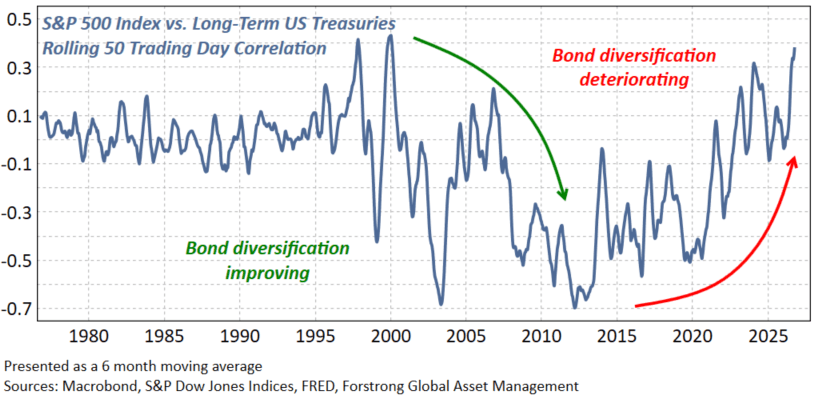
2. Don’t expect bonds to be the hedge they once were. The traditional stock-bond portfolio worked beautifully when recessions meant falling inflation and falling interest rates. In a world of recurring supply shocks and stickier inflation, bonds can fall alongside stocks, making them far less reliable hedges.
3. Welcome back, real assets. Last week, the Dutch central bank made the rather extraordinary decision to shift roughly 78 tonnes of its gold out of New York toward London, citing geopolitical unrest and the need for greater crisis preparedness. Central banks schlepping bullion between jurisdictions is a fairly dramatic expression of a broader trend: investors increasingly want assets that are nobody else’s liability. We don’t expect a dollar collapse or a run on Treasuries, but the steady drip of global capital toward gold, copper and other real assets will continue.
4. Carpe EM. The old caricature of emerging markets as the fiscally irresponsible part of the world is looking increasingly dated: median government debt is roughly 70% of GDP in EM versus 112% in advanced economies. With deepening domestic bond markets, improving credit profiles and attractive real yields, investors increasingly have somewhere else to go for income. Markets have noticed: EM debt has trounced US bonds over the past year.
5. Own the broadening. A 5% world rewards profits today over promises tomorrow. That favours banks, industrials, resource companies and markets outside the US, where valuations are lower, dividends higher and indices far more geared toward the old economy. The 2010s rewarded duration and disruption. This decade will increasingly reward cash flow, capital discipline and the real economy.
Conclusion
Bond risks are rising but 5% need not be a crisis. Investors have been conditioned by the post-GFC era to believe that 1–2% bond yields are normal and 5% is somehow inherently dangerous. But that was the historical anomaly—a world of secular stagnation, deleveraging, austerity, QE and chronic underinvestment.
Today’s world increasingly looks like the mirror image: fiscal activism, reindustrialization, AI capex, defence spending, energy investment and higher nominal growth. Capital has a cost again. But there are also far more productive places to put it.
Perhaps that is the answer to the 5% bond yield puzzle: a strong nominal economy can support higher bond yields and rising corporate profits at the same time. Either way, investors shouldn’t spend the next decade waiting for the last one to come back. Forstrong’s strategies are built around adapting to precisely these moments—when the macro regime changes and yesterday’s investment playbook no longer fits.
Looking for perspective beyond the headlines?

Disclaimers:
The information contained in these materials is for general informational purposes only and is intended to provide only brief comments on broad market, industry or sector trends, or other general economic or market conditions. It is not intended to provide an overview of the terms applicable to any products or funds managed or sponsored by Forstrong Global Asset Management Inc. (“Forstrong”). Views expressed regarding a particular company, security, industry, investment, or market sector are the views only of that individual as of the time expressed and do not necessarily represent the views of Forstrong or any other person in the Forstrong organization. These materials contain information and views as of the date indicated and such information and views are subject to change at any time without notice, based upon market and other conditions, and Forstrong disclaims any and all responsibility to update such information and views. These views are not and may not be relied upon as investment advice and, because investment decisions for a Forstrong fund or product are based on numerous factors, are not and should not be relied upon as an indication of trading intent on behalf of any Forstrong fund or product. Any opinion or assumption may contain elements of subjective judgment and are not intended to imply, nor should be interpreted as conveying, any form of guarantee or assurance by Forstrong of any future action or performance. Neither Forstrong nor any of its affiliates, businesses, or representatives make any representation or warranty, express or implied, as to the accuracy, reliability, completeness, appropriateness, or sufficiency for any purpose of any information contained herein. Forstrong and its affiliates and related entities disclaim any and all liability relating to the information herein, including, without limitation, any express or implied representations or warranties for, statements contained in, and omissions from, the information. Forstrong and its affiliates and related entities are not liable for any errors or omissions in any information herein or for any loss or damage suffered, whether direct or consequential, resulting from the use of these materials.
The information contained in these materials is strictly for general illustrative, educational, or informational purposes, and is not intended to provide legal, investment, accounting, or tax advice, and should not be relied upon in that regard. These materials contain information and views as of the date indicated and such information and views are subject to change at any time without notice, based upon market and other conditions, and Forstrong disclaims any and all responsibility to update such information and views. These views are not and may not be relied upon as investment advice. Any opinion or assumption may contain elements of subjective judgment and are not intended to imply, nor should be interpreted as conveying, any form of guarantee or assurance by Forstrong of any future action or performance. Neither Forstrong nor any of its affiliates, businesses, or representatives make any representation or warranty, express or implied, as to the accuracy, reliability, completeness, appropriateness, or sufficiency for any purpose of any information contained herein. Forstrong and its affiliates and related entities disclaim any and all liability relating to the information herein, including, without limitation, any express or implied representations or warranties for, statements contained in, and omissions from, the information. Forstrong and its affiliates and related entities are not liable for any errors or omissions in any information herein or for any loss or damage suffered, whether direct or consequential, resulting from the use of these materials.
Any specific companies, issuers, funds, ETFs, or indices mentioned are for illustrative or educational purposes only and are not and shall not be deemed to be a recommendation to buy or sell any securities. Any companies, issuers, funds, or ETFs mentioned do not necessarily represent current or future holdings of any Forstrong funds or products. Any strategies discussed are strictly for illustrative and educational purposes and are not a recommendation, offer, or solicitation to buy or sell any securities or to adopt any investment strategy. There is no guarantee that any strategies discussed will be effective.
Commissions, fees, and expenses may be associated with investments in Forstrong funds, ETFs, and/or other investment products. Please read a fund’s offering memorandum or ETF’s prospectus, as applicable, which contains detailed information, and speak to an advisor before investing. Funds and ETFs are not guaranteed, their values change frequently, and investors may experience a gain or loss. Past performance may not be repeated.
Certain statements in these materials may contain forward-looking statements or forward-looking information that are predictive in nature and may include words such as “expects”, “anticipates”, “intends”, “plans”, believes”, “estimates”, and similar forward-looking expressions or negative versions thereof. Such forward-looking statements are based on current expectations and projections about future general economic, political, and other relevant market factors, such as interest, and assuming no changes to applicable tax or other laws or regulations. Expectations and projections about future events are inherently subject to, among other things, risks and uncertainties, some of which may be unforeseeable and, accordingly, may prove to be incorrect at a future date. Forward-looking statements are not guarantees of future performance, and actual events could differ materially from those expressed or implied in any forward-looking statements. A number of important factors can contribute to these differences, including, but not limited to, general economic, political, and market factors in Canada and internationally, interest and foreign exchange rates, global equity and capital markets, business competition, and catastrophic events. You should avoid placing any undue reliance on forward-looking statements. Past performance is no indicator of future performance and the materials are not intended to forecast or predict future events. Forstrong disclaims any and all responsibility to update any forward-looking statements, whether as a result of new information, future events, or otherwise, except as specifically required by law.
The information contained herein is presented solely for illustrative purposes and should not be construed as a forecast or projection. While some information used herein has been obtained from various published and unpublished third-party sources considered to be reliable, such information has not been independently verified by Forstrong (and Forstrong disclaims any obligation to verify) and Forstrong does not guarantee its accuracy or completeness and accepts no liability for any loss or damage suffered, whether direct or consequential, resulting from its use. It should be noted that data provided may be approximate numbers.
Forstrong Global® and the Forstrong Global® logo are trademarks or registered trademarks of Forstrong Global Asset Management Inc. in Canada.
© 2026 Forstrong Global Asset Management Inc. All rights reserved.