
Ask Forstrong
What Would Scare Us Out Of This Bull Market?
October 2026
Ask Forstrong: You’ve remained bullish on global equities despite mounting risks. What would actually make you change your mind?
Key Takeaways
- The bull market is still standing, but risks are mounting. An AI spending slowdown, structurally higher interest rates and a US recession are the three threats that could change our constructive outlook.
- Conviction is one thing. Stubbornness is another. We’re watching for evidence that rising borrowing costs, weakening employment and tighter credit conditions are beginning to undermine the global expansion.
- Investor “vibes” are terrible. Widespread investor anxiety is hardly the hallmark of market euphoria. For now, we favour staying invested, diversifying globally and keeping an open mind.
No footage will be shared, but my seven-year-old daughter has decided what her father will be for Halloween this year. We’re attending a music-themed party, and she’s going as the late Dolly Parton. Nice move. I had planned to go as myself (a middle-aged macro nerd), but she has insisted, unsympathetically and without prior consultation, that I dress as Elvis. Try saying no to an overachieving seven-year-old. Parenthood: the gift that keeps taking.
In other disturbing news, October, with one trading day left in the month, is living up to its reputation as the scariest month for markets. AI capex anxieties refuse to go away. Oil still isn’t flowing freely through the Strait of Hormuz. French bond markets are losing patience with the country’s fiscal profligacy (to be fair, France hasn’t balanced its budget since 1974). And stock market breadth has been downright dreadful since June. While US headline indices hover near record highs, fewer than 25% of S&P 500 stocks are trading above their 50-day moving averages. Apparently, nobody told most stocks about the bull market.
Where to next? We’ve spent the past few weeks talking to clients, the media and, full disclosure, vigorously debating the outlook among our own investment committee. One occupational hazard of investing is falling in love with your own forecasts. Everyone has a worldview. Our worldview remains constructive: the global expansion has further to run, the equity bull market remains intact, and leadership will continue broadening beyond American mega-cap technology. But we’re also convinced that the old macro playbook is obsolete. Higher inflation, fiscal activism, geopolitical fragmentation and the revenge of the real economy are defining a very different investment landscape.
But what if we’re wrong? Conviction is one thing. Stubbornness is another. We haven’t yet seen enough evidence to abandon our framework. But cracks are emerging. Last October, we identified three threats to the bull market (see Is the Winning Streak Over?). Despite those concerns, we concluded — channeling our inner Trump — that “this is still a world with more winning left to do.” Clients benefited from that conviction.
A year later, the bull market is still standing. So are the same three risks. Have they become more threatening? And, more importantly, what would actually make us change our minds?
Risk 1: AI Capex Slowdown
The AI investment boom is shaping up to be one of the largest infrastructure buildouts in history. Estimated annual spending of 3.6% of US GDP through 2032 would dwarf the telecom boom of the 1990s (1.1%), the interstate highway buildout (1.1%) and even the great railroad expansion of the 19th century (2.2%)¹. Total bill? A staggering $10.3 trillion.
But what happens if the spending slows? There are two ways this could unfold.
First, the hyperscalers simply get cold feet. The financial returns from AI remain highly uncertain, while public opposition to power-hungry data centres is growing. Investors are already getting nervous. Meta recently raised its capex guidance despite reporting its first quarter of negative free cash flow since 2012. Revenue surged 26%, but investors sold the stock anyway. The major AI players are expected to generate some $760 billion in cash flow this year, yet their investment commitments could consume all of it and more. The era of capital-light technology companies is clearly over. The question is how long shareholders will tolerate the new reality.
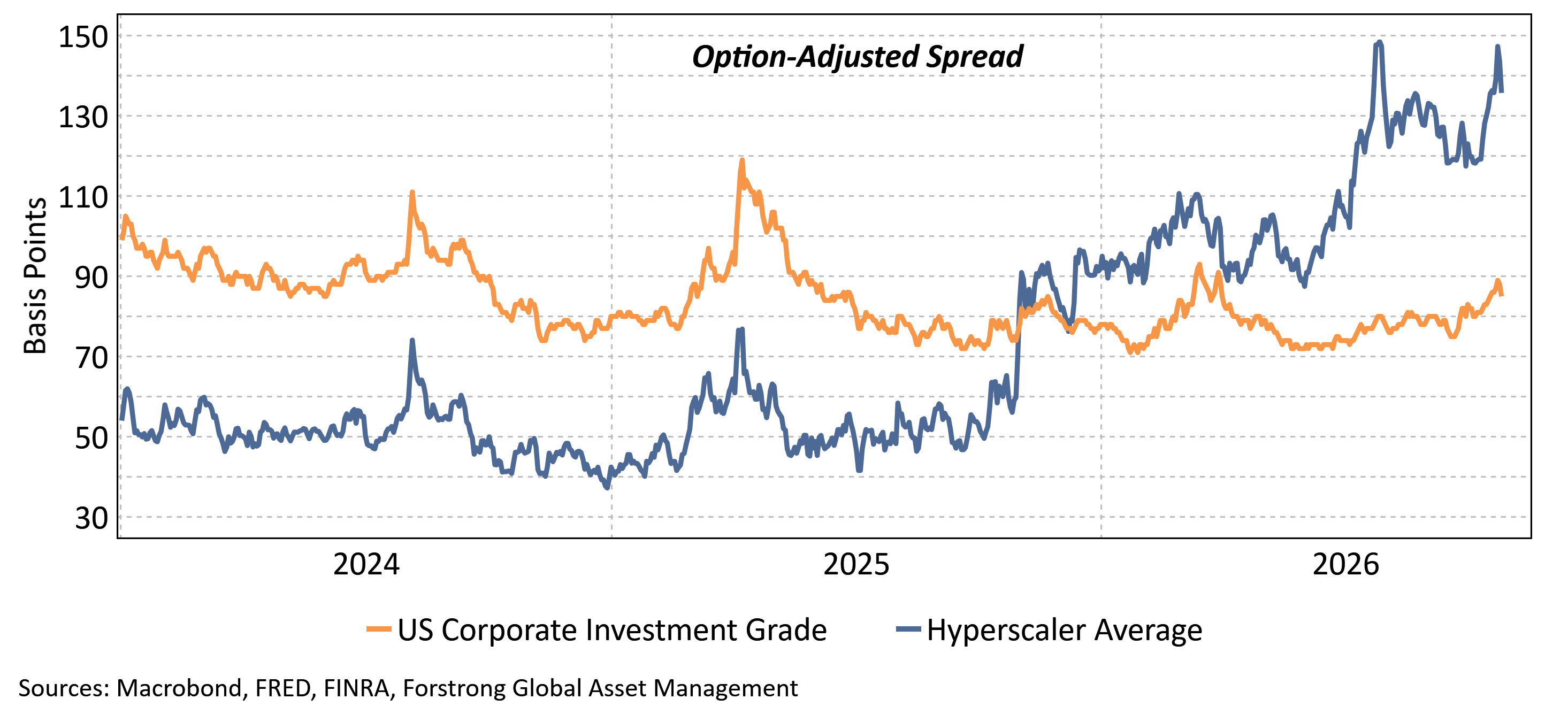
Second, and more ominously, markets force a slowdown. AI is now competing with Uncle Sam for capital. Current borrowing by major AI companies in 2026 is approaching 70% of new long-duration Treasury issuance. The financing binge is reshaping global debt markets. Last month, Japan’s SoftBank reportedly raised more than $11 billion in what was described as the largest junk bond issuance in history to help finance its investment in OpenAI.
Credit cracks are now appearing. Bonds issued by heavily indebted data-centre operators have sold off, while credit default swaps are having a moment. Historically, that’s not something to celebrate. The weakest links are specialized cloud providers like CoreWeave, which depend heavily on expensive external financing. But the risks extend much further. Chipmakers, data-centre operators, power suppliers and private lenders are increasingly financing one another, creating a tangled web of obligations. Trouble in one corner could quickly spread to the rest.
What would change our minds?
Clear evidence that AI spending is being curtailed — not just questioned — as deteriorating cash flows, rising financing costs and tightening credit conditions begin forcing companies to scale back their ambitions.
Risk 2: Inflation and Higher Interest Rates
The AI borrowing binge comes at a fragile moment for global bond markets. Government borrowing costs across the US, UK, Germany and France have climbed to levels last seen in the early 2000s. Everyone has been falling over themselves to explain why (including us — see September’s Ask Forstrong: The 5% Bond Yield Puzzle).
There is no shortage of suspects. A botched war in Iran and the resulting energy shock. A hawkish turn by Fed Chair Kevin Warsh at Jackson Hole. Take your pick. But the forces driving inflation run much deeper and are far more structural. These aren’t problems that can be solved by who runs the Fed or whether missiles are flying over the Persian Gulf.
The real issue? The great disinflationary forces of the past four decades — globalization, fiscal restraint and private-sector deleveraging — have either faded or gone into reverse. In their place: tariffs, chronic fiscal deficits and an unprecedented capital spending boom. Warsh believes AI-driven productivity will soon bring inflation back down. With due respect to the chairman, no it won’t.
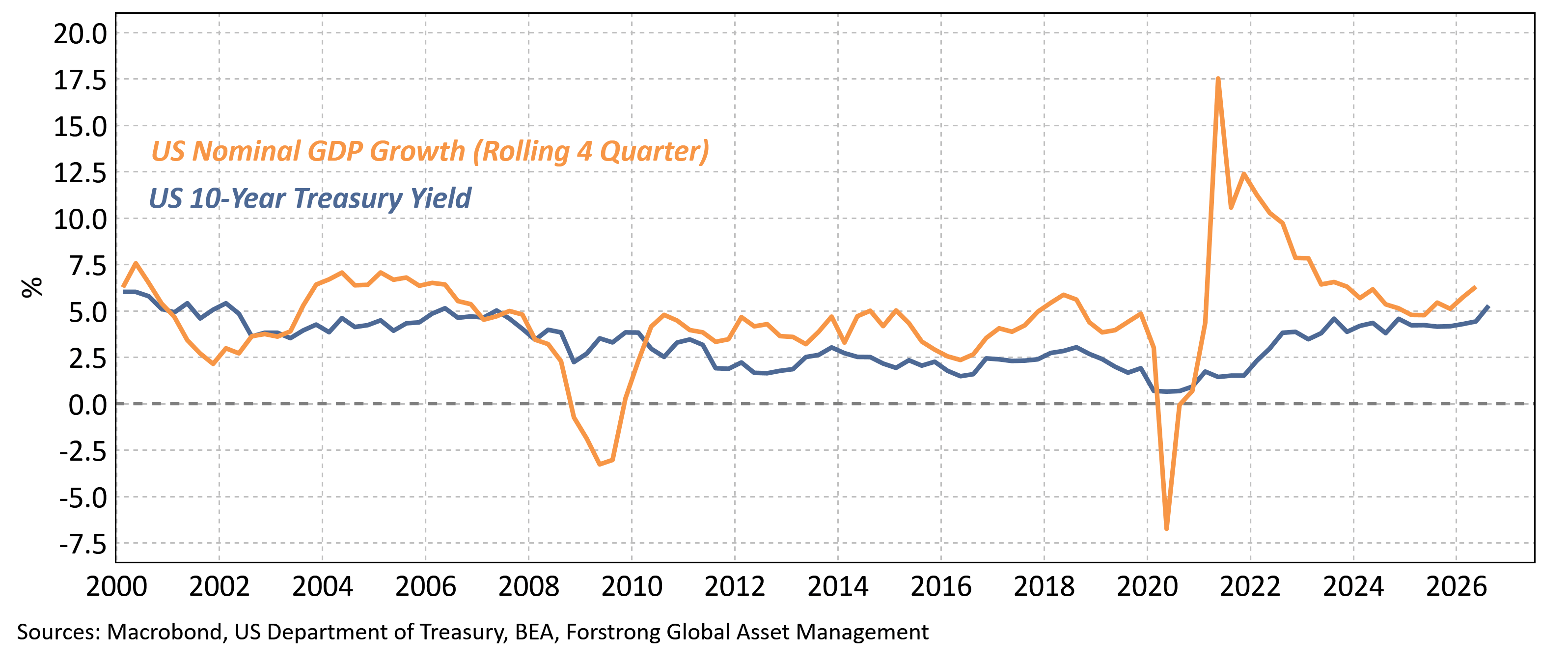
Consider the fiscal backdrop. US deficits remain stuck around 6–7% of GDP, while nominal economic growth is running near 7%. Why should anyone expect the 10-year Treasury yield to return to the low levels of the last decade? The bond market is simply adjusting to a very different world.
Meanwhile, American consumers keep defying the doomsters. They complain bitterly—and understandably—about the affordability crisis, then head straight back to the checkout. The explanation isn’t particularly mysterious: incomes have risen sharply this decade, cumulatively outpacing inflation. For now, employment and wage gains are keeping the consumer remarkably resilient.
The result is an unusual market configuration. Government bond yields are climbing, pockets of speculative credit are flashing warning signs, yet broader corporate credit remains calm and equities continue to advance. Something has to give. Or does it?
History reminds us that rising rates don’t automatically kill bull markets. What matters is why they’re rising. If higher yields reflect stronger nominal growth, improving productivity and rising corporate profits, equities can tolerate surprisingly high interest rates.
What would change our minds?
Evidence that rising yields are no longer reflecting healthy nominal growth but are instead choking off credit, undermining corporate earnings and threatening the broader economic expansion.
Risk 3: US Recession
Everybody has been tiptoeing around the issue, so let’s just come out and say it: inflation is stuck above 3%. And getting it back to 2% without a recession may be considerably harder than central bankers care to admit. That’s the third big risk. The largest bear markets rarely arrive alone. They tend to bring recessions along for company. And with borrowing costs elevated, trade barriers rising and the economy increasingly dependent on AI investment, the ingredients for a downturn aren’t particularly hard to find.
Consider the American economy, which increasingly resembles two parallel universes. In one, hyperscalers are spending money like there’s no tomorrow, building enormous data centres and powering an unprecedented investment boom. In the other, consumers are becoming increasingly stretched. Tariffs aren’t helping. With average US import duties the highest since the 1930s, Washington has effectively imposed another tax on consumption. Economics 101 tells us this slows growth. Wall Street seems happy to skip that chapter.
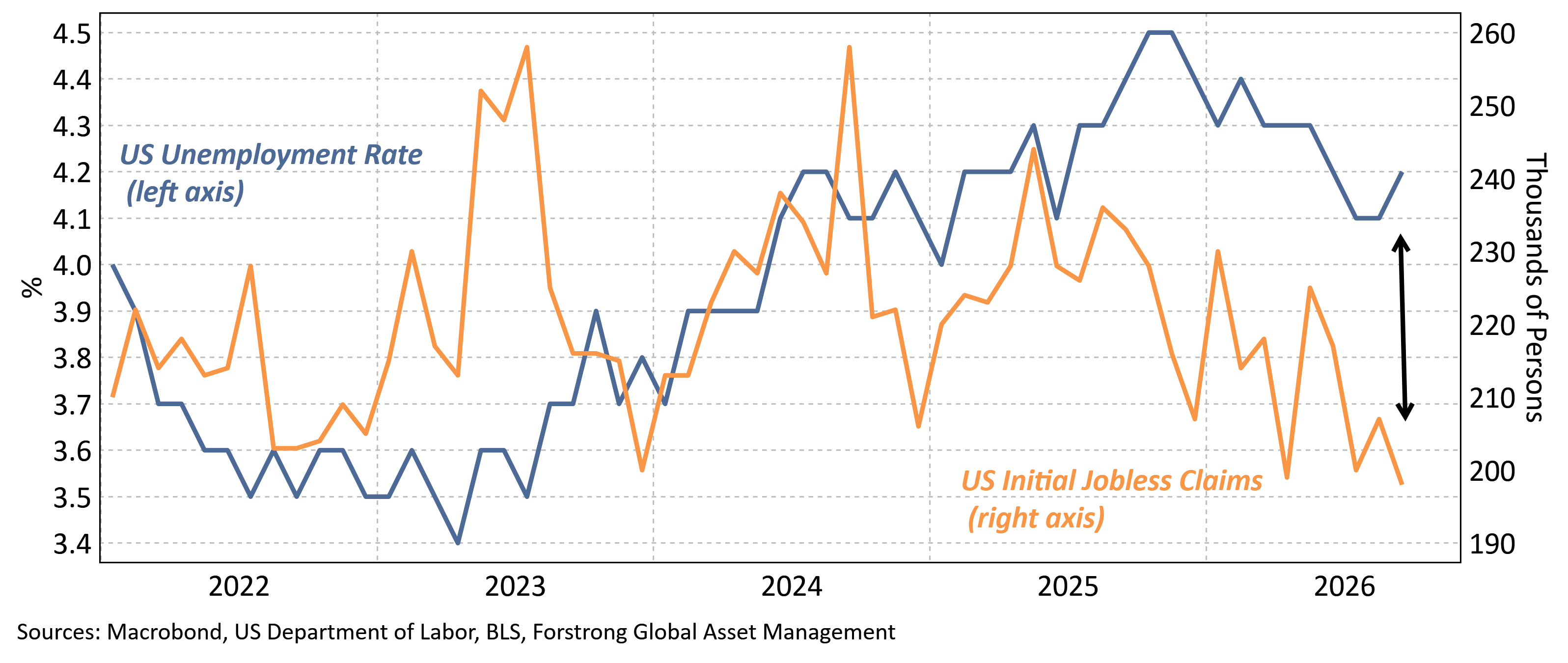
The labour market is the critical link. For now, the economy remains in an uneasy equilibrium of low hiring and low firing. But if employers begin cutting jobs rather than simply slowing recruitment, household spending could deteriorate quickly. And if that coincides with a pullback in AI investment, the two engines of the American economy could sputter at precisely the wrong moment.
There is another uncomfortable possibility: inflation remains stubbornly elevated even as growth weakens. That would leave the Federal Reserve facing the ultimate central banking nightmare — an economy that needs lower interest rates but inflation that won’t allow them.
What would change our minds?
A sustained deterioration in the labour market—particularly a shift from slowing hiring to outright job losses—accompanied by weakening consumer spending and widening credit spreads would signal that the slowdown is becoming something more sinister.
A Final Note on the “Vibes”
After all that, you’d be forgiven for wanting to sell everything and hide under the bed. But here’s the curious thing about this bull market: everyone seems to hate it. Professional investors are fretting about an AI bubble. Central bankers are warning about financial instability. Even the Financial Times is publishing advice on how to protect portfolios from an AI reckoning. Apparently, the apocalypse now comes with an asset allocation guide.
How do you get a euphoric market top when everyone is already convinced the party is about to end? The great market peaks are usually characterized by excessive optimism, not universal anxiety. Investors stop asking what could go wrong and start explaining why nothing possibly can. That’s hardly the prevailing mood today. Of course, gloomy surveys don’t necessarily mean investors have sold their stocks. People can be bearish in interviews and fully invested in their brokerage accounts. But the sheer volume of anxiety suggests this bull market still has a substantial wall of worry to climb.
Our advice remains straightforward, if a little cliché: stay invested. The global expansion has further to run, corporate earnings are growing and the opportunity set is broadening beyond American mega-cap technology. Trying to pinpoint the exact market top and run for the hills may feel savvy at the time. Unfortunately, it requires knowing two things nobody reliably knows: when to get out and when to get back in. We experimented with that approach in our misguided youth. Character-building stuff.
That doesn’t mean ignoring the risks. It means building portfolios that can withstand them. We continue to favour globally diversified equities, including opportunities in Europe, Japan and emerging markets, alongside the real-economy beneficiaries of infrastructure, electrification and capital spending. In a world of structurally higher inflation, equities and real assets remain important sources of protection. And with bond yields finally offering respectable income again, investors can, at long last, put income back to work again.
Above all, stay flexible. Conviction matters, but the willingness to change your mind matters more. We’ll keep watching the evidence rather than the headlines and adjust our positioning when the facts demand it. As for Halloween, I’ve reluctantly accepted my daughter’s advice on costume selection. Elvis it is. Some minds, apparently, cannot be changed.
¹ Estimates from the Brookings Institute.
Looking for perspective beyond the headlines?

Disclaimers:
The information contained in these materials is for general informational purposes only and is intended to provide only brief comments on broad market, industry or sector trends, or other general economic or market conditions. It is not intended to provide an overview of the terms applicable to any products or funds managed or sponsored by Forstrong Global Asset Management Inc. (“Forstrong”). Views expressed regarding a particular company, security, industry, investment, or market sector are the views only of that individual as of the time expressed and do not necessarily represent the views of Forstrong or any other person in the Forstrong organization. These materials contain information and views as of the date indicated and such information and views are subject to change at any time without notice, based upon market and other conditions, and Forstrong disclaims any and all responsibility to update such information and views. These views are not and may not be relied upon as investment advice and, because investment decisions for a Forstrong fund or product are based on numerous factors, are not and should not be relied upon as an indication of trading intent on behalf of any Forstrong fund or product. Any opinion or assumption may contain elements of subjective judgment and are not intended to imply, nor should be interpreted as conveying, any form of guarantee or assurance by Forstrong of any future action or performance. Neither Forstrong nor any of its affiliates, businesses, or representatives make any representation or warranty, express or implied, as to the accuracy, reliability, completeness, appropriateness, or sufficiency for any purpose of any information contained herein. Forstrong and its affiliates and related entities disclaim any and all liability relating to the information herein, including, without limitation, any express or implied representations or warranties for, statements contained in, and omissions from, the information. Forstrong and its affiliates and related entities are not liable for any errors or omissions in any information herein or for any loss or damage suffered, whether direct or consequential, resulting from the use of these materials.
The information contained in these materials is strictly for general illustrative, educational, or informational purposes, and is not intended to provide legal, investment, accounting, or tax advice, and should not be relied upon in that regard. These materials contain information and views as of the date indicated and such information and views are subject to change at any time without notice, based upon market and other conditions, and Forstrong disclaims any and all responsibility to update such information and views. These views are not and may not be relied upon as investment advice. Any opinion or assumption may contain elements of subjective judgment and are not intended to imply, nor should be interpreted as conveying, any form of guarantee or assurance by Forstrong of any future action or performance. Neither Forstrong nor any of its affiliates, businesses, or representatives make any representation or warranty, express or implied, as to the accuracy, reliability, completeness, appropriateness, or sufficiency for any purpose of any information contained herein. Forstrong and its affiliates and related entities disclaim any and all liability relating to the information herein, including, without limitation, any express or implied representations or warranties for, statements contained in, and omissions from, the information. Forstrong and its affiliates and related entities are not liable for any errors or omissions in any information herein or for any loss or damage suffered, whether direct or consequential, resulting from the use of these materials.
Any specific companies, issuers, funds, ETFs, or indices mentioned are for illustrative or educational purposes only and are not and shall not be deemed to be a recommendation to buy or sell any securities. Any companies, issuers, funds, or ETFs mentioned do not necessarily represent current or future holdings of any Forstrong funds or products. Any strategies discussed are strictly for illustrative and educational purposes and are not a recommendation, offer, or solicitation to buy or sell any securities or to adopt any investment strategy. There is no guarantee that any strategies discussed will be effective.
Commissions, fees, and expenses may be associated with investments in Forstrong funds, ETFs, and/or other investment products. Please read a fund’s offering memorandum or ETF’s prospectus, as applicable, which contains detailed information, and speak to an advisor before investing. Funds and ETFs are not guaranteed, their values change frequently, and investors may experience a gain or loss. Past performance may not be repeated.
Certain statements in these materials may contain forward-looking statements or forward-looking information that are predictive in nature and may include words such as “expects”, “anticipates”, “intends”, “plans”, believes”, “estimates”, and similar forward-looking expressions or negative versions thereof. Such forward-looking statements are based on current expectations and projections about future general economic, political, and other relevant market factors, such as interest, and assuming no changes to applicable tax or other laws or regulations. Expectations and projections about future events are inherently subject to, among other things, risks and uncertainties, some of which may be unforeseeable and, accordingly, may prove to be incorrect at a future date. Forward-looking statements are not guarantees of future performance, and actual events could differ materially from those expressed or implied in any forward-looking statements. A number of important factors can contribute to these differences, including, but not limited to, general economic, political, and market factors in Canada and internationally, interest and foreign exchange rates, global equity and capital markets, business competition, and catastrophic events. You should avoid placing any undue reliance on forward-looking statements. Past performance is no indicator of future performance and the materials are not intended to forecast or predict future events. Forstrong disclaims any and all responsibility to update any forward-looking statements, whether as a result of new information, future events, or otherwise, except as specifically required by law.
The information contained herein is presented solely for illustrative purposes and should not be construed as a forecast or projection. While some information used herein has been obtained from various published and unpublished third-party sources considered to be reliable, such information has not been independently verified by Forstrong (and Forstrong disclaims any obligation to verify) and Forstrong does not guarantee its accuracy or completeness and accepts no liability for any loss or damage suffered, whether direct or consequential, resulting from its use. It should be noted that data provided may be approximate numbers.
Forstrong Global® and the Forstrong Global® logo are trademarks or registered trademarks of Forstrong Global Asset Management Inc. in Canada.
© 2026 Forstrong Global Asset Management Inc. All rights reserved.