
Ask Forstrong
The Iran Shock: Why Markets May Already Be Moving On
April 2026
Ask Forstrong: The war in Iran looks set to drag on. What should investors do now?
Key Takeaways
-
The oil shock is spreading but not breaking the system. Roughly 3 billion people are now feeling higher energy and food costs, yet the transmission is complex and not a simple recession or “risk off” trigger.
-
Investors are anchored to the wrong playbook. This isn’t the 1970s. Oil matters, but a more flexible, less energy-intensive world reduces its macro punch.
-
Market declines are creating opportunity. With sentiment washed out and beginning to recover, investors have a second chance to lock onto this cycle’s dominant themes —international equity leadership and select commodity exposures tied to the real economy.
Markets have now had a month to digest the Iran shock. Missiles are still flying. Talks in Islamabad between Washington and Tehran have collapsed. And the chokehold on the Strait of Hormuz has gone from a theoretical black swan to a live pressure point in the global economy. Some historians are already calling this America’s “Suez moment,” a reference to the 1956 crisis that marked the peaking out of the British and French empires.
All of this is bleak stuff. But the key question remains: has anything fundamentally changed?
As we argued in last month’s “A Crash Course In Oil Shocks”, investors need to separate what feels dramatic from what actually drives markets over time.
The past month has given us more information. The task now is deciding what actually matters.
What’s Actually Changed?
Real Economic Impact. The oil shock is now moving from markets into the real economy. Iran’s weaponization of the Strait has turned a regional conflict into a global cost shock. Roughly 3 billion people in lower income nations — including India, Pakistan, and China (each with varying friendly ties to Iran) — are now feeling the effects of higher energy and food costs. These economies sit at the core of global manufacturing. If the shock persists, it won’t stay local — it will flow straight through to global inflation and interest rates. This is the core risk that matters.
A Deeply Unpopular War. The war is deeply unpopular in America, with midterms approaching. Prolonged conflict, higher gasoline prices, and falling approval ratings are not a winning combination. That shifts the incentive structure. Markets are now trying to price not just escalation but the probability of policy-driven de-escalation. Political pressure to contain the situation is building.
Anchoring Bias. In times of stress, investors always scramble for a familiar anchor to the past. Last year, tariffs were going to send us back to the 1930s. This year, oil is supposedly taking us to the 1970s. Neither analogy fits. The world today is structurally different. The global economy is far less oil-intensive — crude usage peaked after the 1973 Arab embargo and has since fallen by roughly 60% per unit of real GDP. Supply is more diversified. Trade flows are more adaptable. Oil shocks still matter. But they are less inflationary and less economically destructive than they once were. Today, the bigger mistake isn’t underestimating the shock. It’s overestimating its ability to dominate the entire macro landscape. Markets love a simple story. Reality is rarely that cooperative.
Fog Of War. Markets never wait for clarity. They turn when visibility is at its worst. Looking back over the past century, stock markets have typically bottomed within the first 10% of a conflict’s duration (hat tip to Tom Lee). Even during World War II, markets moved higher well before the outcome was clear — and long before American troops were fully deployed in Europe. All told, the S&P 500 rose by half during the second world war. Why? Because markets are forward-looking. They price the likely future and not the headlines. The Iran war may persist. History suggests it likely will. But conflicts have a way of fading into the background once the initial shock is absorbed. They simply stop mattering as much to markets. The Russia–Ukraine war is a recent example. The conflict continues to rage but no longer drives daily market direction. The takeaway is straightforward: war-gaming geopolitical scenarios is a losing exercise. Unless someone at the Pentagon is tipping you off (in which case, please don’t call our office). Investors are far better served focusing on what markets are actually telling them.
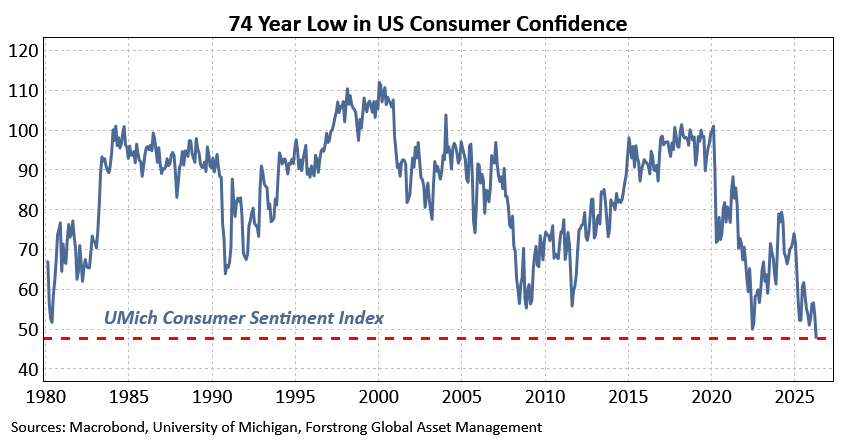
Sentiment Has Collapsed. By some behavioural measures, the recent panic rivals the COVID washout. The University of Michigan consumer confidence survey — running for 74 years — has just recorded its lowest reading on record. Lower than the financial crisis. Lower than the pandemic. Unfortunately, markets never offer an “all clear” signal. But historically, when sentiment reaches extremes like this, the bar for positive surprises falls sharply.
What Still Matters?
The most important question is not how the war unfolds but whether it changes the underlying trends driving markets. So far, the answer appears to be no. If anything, it is accelerating them. As my market-savvy colleague David Kletz has noted, second and third-order effects matter most. Geopolitical shocks often become catalysts for energy security investment, defense spending and infrastructure buildouts.
We have seen a version of this movie before. Last year, tariffs were initially framed as a growth headwind. Instead, they accelerated reshoring, industrial policy, and fiscal expansion right across the world. The same dynamic is playing out again.
Looking ahead, three structural forces continue to anchor the cycle:
Deficits Are Here To Stay. The pandemic normalized large-scale fiscal intervention. Few politicians recite the numbers today but for those counting some $5 trillion of COVID relief funding in the US was more than 10 times gross disbursements from the financial crisis. What began as emergency stimulus has evolved into a structural feature of the system. Equally important is the institutionalization of the government rescue reflex. Whether in banking stress, energy crises or geopolitical shocks, policymakers increasingly turn to fiscal support rather than interest rate cuts. This has consequences. It removes deflationary tail risks and shortens the duration of downturns. It also skews the range of potential outcomes towards higher inflation and higher asset prices. There is also a simple linkage at work: massive fiscal deficits always translate into massive corporate profits (sorry, we don’t make the equations). Don’t expect government deficits to get any less eye-watering.
Capex Cycle Is Alive. The world is in the midst of a global capex revolt — one that is often mischaracterized as a purely AI story. It isn’t. Since 2020, the American economy has experienced one of the strongest capex upcycles in decades. Industrial metals have been rallying through it all, even as Chinese real estate has been under pressure. These are not moves driven by chips alone. They reflect something broader: rearmament, reindustrialization, and the rebuilding of supply chains for a tricky era of geopolitical uncertainty. War and capex tend to move in lockstep.
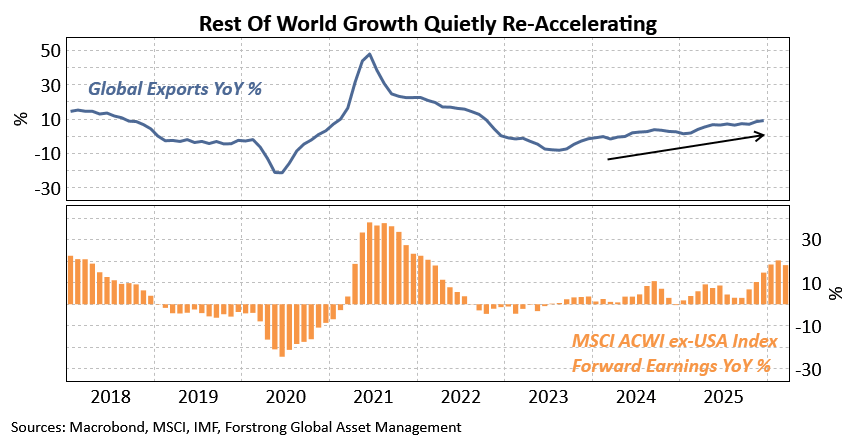
Global Growth Re-Acceleration. Global growth is reaccelerating. Yes, energy shocks and tighter financial conditions introduce risks. Confidence can wobble. Margins can get squeezed. But the broader signal from leading indicators still points toward improvement, not deterioration. For much of the past decade, earnings growth was synonymous with the United States. Crucially, that dynamic is now shifting. Earnings growth outside the US is turning decisively higher, with Europe, Japan, and parts of emerging markets showing clear signs of inflection. Hardly what one would expect heading into a downturn. The result is a more resilient global growth environment — one that may prove uneven, but far less fragile than the headlines suggest. If that’s the macro picture, the market’s insipient rally starts to make more sense.
Where to Position Portfolios?
What does this all mean for investors? First, leadership continues to evolve. Watching what leads out of crisis-driven selling often provides clues on what will lead in the next risk-on phase. Software and AI-related equities, last cycle’s undisputed winners, have been under renewed pressure. An index of SaaS stocks is down nearly 40% in 2026 as investors reassess both valuations and second-order effects from AI itself. Big Tech’s business model as an asset-light monopoly franchise is now also being challenged. The hyperscalers are increasingly capital-hungry, more competitive and less insulated. Markets assign very different multiples to that kind of business.
Second, safe havens are changing. The US dollar briefly rallied in the initial stages of the oil shock — then quickly faded. Treasuries have seen outflows. Capital is no longer reflexively flowing into traditional defensive assets. Instead, it is finding its way into less obvious places. China is a notable example. Despite being the world’s largest oil importer, its markets have held up better, supported by large energy reserves, diversified supply chains and a more electrified economy. In a world of supply shocks, resilience — not ideology — is becoming the defining characteristic of a safe haven.
Third, international equities. The recent pullback has been driven by familiar forces, namely hot money retreating during periods of volatility. But structurally, the case for international exposure remains intact. Markets in Japan, Europe, and parts of emerging markets have sold off while earnings forecasts have, at long last, turned decisively higher.
Finally, commodities continue to stand out. We remain constructive on industrial metals —particularly copper — which act as “triple plays” on rearmament, reindustrialization, and AI-driven demand. Oil is more nuanced. In the short term, disruption supports prices and recent strikes have inflicted serious damage on energy infrastructure across the Middle East, complicating the supply outlook. But over the longer term, the setup is less constructive. A reopening of the Strait would trigger aggressive supply responses from Gulf producers, alongside incremental barrels from other nations. We are watching closely for a reversal in oil prices later this year — unlikely as that may seem today.
Crises always feel like turning points. Most of them aren’t. The Iran shock is real. Yet at this stage, the broader macro framework remains intact. Markets are adjusting to a disruption not a new regime. But by the time the fog clears, markets will have already moved on.
Looking for perspective beyond the headlines?

Disclaimers:
The information contained in these materials is for general informational purposes only and is intended to provide only brief comments on broad market, industry or sector trends, or other general economic or market conditions. It is not intended to provide an overview of the terms applicable to any products or funds managed or sponsored by Forstrong Global Asset Management Inc. (“Forstrong”). Views expressed regarding a particular company, security, industry, investment, or market sector are the views only of that individual as of the time expressed and do not necessarily represent the views of Forstrong or any other person in the Forstrong organization. These materials contain information and views as of the date indicated and such information and views are subject to change at any time without notice, based upon market and other conditions, and Forstrong disclaims any and all responsibility to update such information and views. These views are not and may not be relied upon as investment advice and, because investment decisions for a Forstrong fund or product are based on numerous factors, are not and should not be relied upon as an indication of trading intent on behalf of any Forstrong fund or product. Any opinion or assumption may contain elements of subjective judgment and are not intended to imply, nor should be interpreted as conveying, any form of guarantee or assurance by Forstrong of any future action or performance. Neither Forstrong nor any of its affiliates, businesses, or representatives make any representation or warranty, express or implied, as to the accuracy, reliability, completeness, appropriateness, or sufficiency for any purpose of any information contained herein. Forstrong and its affiliates and related entities disclaim any and all liability relating to the information herein, including, without limitation, any express or implied representations or warranties for, statements contained in, and omissions from, the information. Forstrong and its affiliates and related entities are not liable for any errors or omissions in any information herein or for any loss or damage suffered, whether direct or consequential, resulting from the use of these materials.
The information contained in these materials is strictly for general illustrative, educational, or informational purposes, and is not intended to provide legal, investment, accounting, or tax advice, and should not be relied upon in that regard. These materials contain information and views as of the date indicated and such information and views are subject to change at any time without notice, based upon market and other conditions, and Forstrong disclaims any and all responsibility to update such information and views. These views are not and may not be relied upon as investment advice. Any opinion or assumption may contain elements of subjective judgment and are not intended to imply, nor should be interpreted as conveying, any form of guarantee or assurance by Forstrong of any future action or performance. Neither Forstrong nor any of its affiliates, businesses, or representatives make any representation or warranty, express or implied, as to the accuracy, reliability, completeness, appropriateness, or sufficiency for any purpose of any information contained herein. Forstrong and its affiliates and related entities disclaim any and all liability relating to the information herein, including, without limitation, any express or implied representations or warranties for, statements contained in, and omissions from, the information. Forstrong and its affiliates and related entities are not liable for any errors or omissions in any information herein or for any loss or damage suffered, whether direct or consequential, resulting from the use of these materials.
Any specific companies, issuers, funds, ETFs, or indices mentioned are for illustrative or educational purposes only and are not and shall not be deemed to be a recommendation to buy or sell any securities. Any companies, issuers, funds, or ETFs mentioned do not necessarily represent current or future holdings of any Forstrong funds or products. Any strategies discussed are strictly for illustrative and educational purposes and are not a recommendation, offer, or solicitation to buy or sell any securities or to adopt any investment strategy. There is no guarantee that any strategies discussed will be effective.
Commissions, fees, and expenses may be associated with investments in Forstrong funds, ETFs, and/or other investment products. Please read a fund’s offering memorandum or ETF’s prospectus, as applicable, which contains detailed information, and speak to an advisor before investing. Funds and ETFs are not guaranteed, their values change frequently, and investors may experience a gain or loss. Past performance may not be repeated.
Certain statements in these materials may contain forward-looking statements or forward-looking information that are predictive in nature and may include words such as “expects”, “anticipates”, “intends”, “plans”, believes”, “estimates”, and similar forward-looking expressions or negative versions thereof. Such forward-looking statements are based on current expectations and projections about future general economic, political, and other relevant market factors, such as interest, and assuming no changes to applicable tax or other laws or regulations. Expectations and projections about future events are inherently subject to, among other things, risks and uncertainties, some of which may be unforeseeable and, accordingly, may prove to be incorrect at a future date. Forward-looking statements are not guarantees of future performance, and actual events could differ materially from those expressed or implied in any forward-looking statements. A number of important factors can contribute to these differences, including, but not limited to, general economic, political, and market factors in Canada and internationally, interest and foreign exchange rates, global equity and capital markets, business competition, and catastrophic events. You should avoid placing any undue reliance on forward-looking statements. Past performance is no indicator of future performance and the materials are not intended to forecast or predict future events. Forstrong disclaims any and all responsibility to update any forward-looking statements, whether as a result of new information, future events, or otherwise, except as specifically required by law.
The information contained herein is presented solely for illustrative purposes and should not be construed as a forecast or projection. While some information used herein has been obtained from various published and unpublished third-party sources considered to be reliable, such information has not been independently verified by Forstrong (and Forstrong disclaims any obligation to verify) and Forstrong does not guarantee its accuracy or completeness and accepts no liability for any loss or damage suffered, whether direct or consequential, resulting from its use. It should be noted that data provided may be approximate numbers.
Forstrong Global® and the Forstrong Global® logo are trademarks or registered trademarks of Forstrong Global Asset Management Inc. in Canada.
© 2026 Forstrong Global Asset Management Inc. All rights reserved.