
Ask Forstrong
Iran War: A Crash
Course In Oil Shocks
March 2026
Ask Forstrong: Markets are falling on news of a widening conflict in the Middle East. Should investors be worried?
Key Takeaways
- Geopolitical shocks rarely derail markets. History shows wars and crises typically trigger short-term volatility, not lasting bear markets.
- Oil shocks are the real risk but today’s carry less macro punch. A more flexible global energy system and less energy-intensive economies make oil spikes far less damaging than in the 1970s.
- Recession risks have risen, but a major portfolio de-risking remains premature. The global economy entered this conflict with solid momentum.
Buckle up, ladies and gentlemen. War has returned to the front pages. Missiles are flying, oil traders are scrambling, and markets are doing what they always do in moments like this: sell first and ask questions later.
But the main question investors are asking is simple: does this change the overall market outlook?
These episodes always feel uniquely dangerous while they are unfolding. And, at a human level, they are. We have friends and contacts across the Middle East who are deeply concerned. The current situation is particularly unsettling, as the conflict has broadened across the region and introduced new elements of unpredictability, including Iran’s use of drone technology.
But when the newsfeed turns visceral and dramatic, it’s tempting to assume that something fundamental has changed. More often than not, it hasn’t. Markets have endured wars, invasions, terrorist attacks, and geopolitical shocks of every variety. Yet, over longer periods, they have continued to follow the same forces that have always driven returns: earnings, economic growth, and the cost of capital. That distinction matters more than ever right now.
The problem, of course, is that traditional financial modelling offers no help during times like these. Geopolitical shocks are the very definition of “black swans”— events that arrive suddenly and defy prediction. Rather than attempting the impossible task of forecasting one of the many possible outcomes, investors are better served by looking backwards. What actually happened to markets the last time the world seemed to be falling apart?
Here, the historical record is surprisingly consistent. When geopolitical crises erupt, financial markets tend to move through the same emotional stages investors do: shock, fear, and eventually perspective (and often large government policy responses).
Rummaging through past cross-border conflicts produces a long list of surprisingly strong market returns. Stocks almost always fall initially as markets scramble to price risk. But once the uncertainty begins to clear — even if the conflict itself continues — markets tend to recover quickly. Consider the Cuban Missile Crisis in October 1962, a 13-day standoff widely regarded as the closest the Cold War came to nuclear conflict. Once the initial panic passed, the Dow went on to gain more than 10% that year. Or take the Korean War. When North Korea invaded the South in June 1950, markets initially sold off sharply. Yet by the time the war ended in 1953, the Dow had delivered annualized returns of roughly 13%. History is brimming with similar examples.
But there is an important caveat. Not all geopolitical shocks are created equal. Most fade quickly once the headlines pass. Since 1940, the S&P 500 has been higher 12 months after a major geopolitical crisis 85% of the time (hat tip to BCA Research). But a select few ripple through the real economy and leave a much deeper mark on markets. Which raises an obvious question: if wars rarely derail markets for long, when do they actually matter?
The answer is surprisingly narrow. Geopolitical shocks only tend to have lasting market consequences when they disrupt the real economy. And in modern history, the main transmission channel has almost always been the same: oil. When prices spike sharply, the effects ripple through transportation, manufacturing, food prices, and ultimately inflation. Central banks then face an uncomfortable dilemma. They can raise interest rates to cool an overheating economy. But they can’t raise rates to produce more oil, reopen shipping lanes, or end wars. Supply shocks simply don’t respond to the normal tools of monetary policy.
Are The 1970s Calling?
This dynamic has been particularly relevant in recent years. Since 2020, central banks haven’t faced a normal demand-driven cycle. Instead, they have had to navigate a sequence of supply shocks: COVID, the war in Ukraine, trade tensions and tariffs, and now rising tensions in the Middle East.
Which raises the question we are getting from clients: are the 1970s calling? Back then, a series of energy shocks — first the 1973 Arab oil embargo (where crude prices quadrupled), then the 1979 Iranian revolution — sent oil prices soaring and inflation with them. Policymakers found themselves trapped between slowing growth and rising prices. Recessions followed, and investors learned the hard way that geopolitics could overwhelm the normal rhythm of the business cycle.
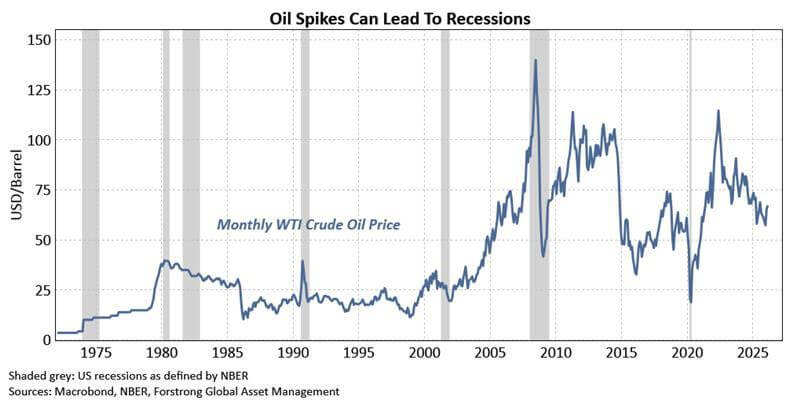
But today’s oil shocks may not carry the same macroeconomic punch.
First, the global energy system is far more flexible than it was fifty years ago. Back then, OPEC controlled roughly half of global production and most internationally traded oil. Today its share is closer to a third. US shale production, Canadian oil sands, and new offshore supply from places like Brazil have dramatically diversified global output.
Second, global trade flows have become remarkably adaptable. Even large geopolitical shocks are often absorbed through shrewd multipedal and backdoor political maneuvering that keeps cross-border trade booming. The experience of the Russia–Ukraine war offers a good example. Despite sweeping Western sanctions, Russian oil exports were quickly rerouted to buyers in countries such as India and Turkey, limiting the disruption to global supply.
Third, the global economy itself has become far less energy-intensive. The US economy now uses roughly 70% less oil than it did in the 1970s to produce the same amount of output, while consumer spending on energy as a share of personal income remains near historical lows.
Oil shocks, of course, still matter. But they are far less inflationary than they once were and are far less likely to derail the global economy on their own.
What We’re Watching
None of this means investors should dismiss the risks. Geopolitical shocks are notoriously difficult to handicap, and the current situation does materially raise recession risks. It’s not clear how Trump can simply “TACO” out of this crisis (the Wall Street acronym for Trump Always Chickens Out). This isn’t tariffs or Greenland annexation. It will take two sides willing to TACO.
Investors need to stay open-minded. But rather than attempting to predict how events unfold, our investment team is focused on a small set of market signals that historically determine whether geopolitical shocks remain temporary disruptions or evolve into something more serious.
Four signals matter most:
Shape of the Oil Curve:
The key question is whether the current spike proves temporary or evolves into a sustained surge that feeds through to inflation and economic activity. One signal to watch is the oil futures curve, which is currently heavily backwardated. If backwardation begins to ease — with longer-dated contracts rising faster than the front month — it would suggest the market is starting to price a more persistent supply shock.
Rising Inflation Expectations:
If higher energy prices begin pushing inflation expectations upward, central banks will have far less flexibility to support growth.
Deteriorating Financial Conditions:
We are watching whether stress spreads through markets via wider credit spreads, tighter liquidity, or deteriorating funding conditions, particularly as concerns about AI hyperscaler profitability and risks in private credit had already been rising.
Strength in the US Dollar:
Sharp dollar appreciation can tighten global financial conditions and amplify market stress, especially during periods of geopolitical uncertainty.
Investment Implications
Crises often reveal shifts already underway in markets. This episode is no exception. Most notably absent has been the traditional rush into Western government bonds. That reflects a reality investors have been slowly adjusting to: in a world of persistent supply shocks and structurally higher inflation, government bonds are no longer the reliable hedge they once were. Instead, a new set of safe havens is emerging — most notably commodities, which benefit when geopolitical tension and resource scarcity rise.
At the same time, it would be premature to make a major portfolio de-risking. The global economy entered this conflict with considerable momentum. Trade growth has been improving, activity in Europe and Japan is beginning to reaccelerate, and China’s economy remains stable. Even after the recent spike, global spending on crude oil as a share of GDP still sits near the bottom of its multi-decade range. Prices would need to rise further before they seriously threaten the expansion.
For now, the broader macro landscape looks largely unchanged. Leadership continues to broaden beyond America’s Big Tech companies that dominated the last decade, rotating toward real economy sectors and international markets. If anything, the current crisis may accelerate several structural trends already underway, reinforcing the global capex cycle tied to defense, decarbonization, and reindustrialization.
Geopolitical shocks may interrupt markets temporarily. But they rarely change the direction of travel. We are watching the signals closely to see if this time proves different.
Looking for perspective beyond the headlines?

Disclaimers:
The information contained in these materials is for general informational purposes only and is intended to provide only brief comments on broad market, industry or sector trends, or other general economic or market conditions. It is not intended to provide an overview of the terms applicable to any products or funds managed or sponsored by Forstrong Global Asset Management Inc. (“Forstrong”). Views expressed regarding a particular company, security, industry, investment, or market sector are the views only of that individual as of the time expressed and do not necessarily represent the views of Forstrong or any other person in the Forstrong organization. These materials contain information and views as of the date indicated and such information and views are subject to change at any time without notice, based upon market and other conditions, and Forstrong disclaims any and all responsibility to update such information and views. These views are not and may not be relied upon as investment advice and, because investment decisions for a Forstrong fund or product are based on numerous factors, are not and should not be relied upon as an indication of trading intent on behalf of any Forstrong fund or product. Any opinion or assumption may contain elements of subjective judgment and are not intended to imply, nor should be interpreted as conveying, any form of guarantee or assurance by Forstrong of any future action or performance. Neither Forstrong nor any of its affiliates, businesses, or representatives make any representation or warranty, express or implied, as to the accuracy, reliability, completeness, appropriateness, or sufficiency for any purpose of any information contained herein. Forstrong and its affiliates and related entities disclaim any and all liability relating to the information herein, including, without limitation, any express or implied representations or warranties for, statements contained in, and omissions from, the information. Forstrong and its affiliates and related entities are not liable for any errors or omissions in any information herein or for any loss or damage suffered, whether direct or consequential, resulting from the use of these materials.
The information contained in these materials is strictly for general illustrative, educational, or informational purposes, and is not intended to provide legal, investment, accounting, or tax advice, and should not be relied upon in that regard. These materials contain information and views as of the date indicated and such information and views are subject to change at any time without notice, based upon market and other conditions, and Forstrong disclaims any and all responsibility to update such information and views. These views are not and may not be relied upon as investment advice. Any opinion or assumption may contain elements of subjective judgment and are not intended to imply, nor should be interpreted as conveying, any form of guarantee or assurance by Forstrong of any future action or performance. Neither Forstrong nor any of its affiliates, businesses, or representatives make any representation or warranty, express or implied, as to the accuracy, reliability, completeness, appropriateness, or sufficiency for any purpose of any information contained herein. Forstrong and its affiliates and related entities disclaim any and all liability relating to the information herein, including, without limitation, any express or implied representations or warranties for, statements contained in, and omissions from, the information. Forstrong and its affiliates and related entities are not liable for any errors or omissions in any information herein or for any loss or damage suffered, whether direct or consequential, resulting from the use of these materials.
Any specific companies, issuers, funds, ETFs, or indices mentioned are for illustrative or educational purposes only and are not and shall not be deemed to be a recommendation to buy or sell any securities. Any companies, issuers, funds, or ETFs mentioned do not necessarily represent current or future holdings of any Forstrong funds or products. Any strategies discussed are strictly for illustrative and educational purposes and are not a recommendation, offer, or solicitation to buy or sell any securities or to adopt any investment strategy. There is no guarantee that any strategies discussed will be effective.
Commissions, fees, and expenses may be associated with investments in Forstrong funds, ETFs, and/or other investment products. Please read a fund’s offering memorandum or ETF’s prospectus, as applicable, which contains detailed information, and speak to an advisor before investing. Funds and ETFs are not guaranteed, their values change frequently, and investors may experience a gain or loss. Past performance may not be repeated.
Certain statements in these materials may contain forward-looking statements or forward-looking information that are predictive in nature and may include words such as “expects”, “anticipates”, “intends”, “plans”, believes”, “estimates”, and similar forward-looking expressions or negative versions thereof. Such forward-looking statements are based on current expectations and projections about future general economic, political, and other relevant market factors, such as interest, and assuming no changes to applicable tax or other laws or regulations. Expectations and projections about future events are inherently subject to, among other things, risks and uncertainties, some of which may be unforeseeable and, accordingly, may prove to be incorrect at a future date. Forward-looking statements are not guarantees of future performance, and actual events could differ materially from those expressed or implied in any forward-looking statements. A number of important factors can contribute to these differences, including, but not limited to, general economic, political, and market factors in Canada and internationally, interest and foreign exchange rates, global equity and capital markets, business competition, and catastrophic events. You should avoid placing any undue reliance on forward-looking statements. Past performance is no indicator of future performance and the materials are not intended to forecast or predict future events. Forstrong disclaims any and all responsibility to update any forward-looking statements, whether as a result of new information, future events, or otherwise, except as specifically required by law.
The information contained herein is presented solely for illustrative purposes and should not be construed as a forecast or projection. While some information used herein has been obtained from various published and unpublished third-party sources considered to be reliable, such information has not been independently verified by Forstrong (and Forstrong disclaims any obligation to verify) and Forstrong does not guarantee its accuracy or completeness and accepts no liability for any loss or damage suffered, whether direct or consequential, resulting from its use. It should be noted that data provided may be approximate numbers.
Forstrong Global® and the Forstrong Global® logo are trademarks or registered trademarks of Forstrong Global Asset Management Inc. in Canada.
© 2026 Forstrong Global Asset Management Inc. All rights reserved.