
Ask Forstrong
What’s So Special About The
K-Shaped Economy?
November 2025
Ask Forstrong: Every new data release seems to tell a different story. What should investors focus on?
Key Takeaways
- The K-shaped global economy has created broad investor confusion — an environment prone to portfolio errors.
- At the same time, K-shapes have also produced enormous crowding and concentrated investor positioning.
- As markets head into 2026, rotation and broadening will be continuing themes — expect trends like international equity outperformance to persist.
Some recoveries come in tidy shapes — the V-shaped rebound, the U-shaped slowdown or even the long-suffering L. But today’s expansion looks more like a K: a winner-takes-all world split between the haves and have-nots. The upper stroke represents those riding policy tailwinds, asset booms, and technological revolutions. The lower stroke is everyone else left behind — lower-income workers, small businesses and sectors still reliant on old-fashioned face-to-face interaction (hospitality, travel, retail and the like).
Never has the world seen such extreme divergences. Two trends stand out. First, all things AI. Corporate spending on artificial intelligence now accounts for roughly half of US GDP growth this year. AI-linked companies alone have delivered nearly 80% of the S&P 500’s gains in 2025. By contrast, the consumer economy is sputtering. The list of firms posting negative real revenue growth includes Nike, Williams-Sonoma, Wynn Resorts, Procter & Gamble, nearly every public homebuilder and a whole host of others. Meanwhile, the US labour market has gone soft, with employers slashing more than 150,000 jobs in October, the largest monthly wave of layoffs since 2003.
The second trend is the boom among the already-booming. The wealthiest 10% of Americans own 85% of US stocks and therefore enjoy the largest wealth effect when markets rise. Unsurprisingly, the top 10% of earners now account for half of all consumer spending — the highest share on record. America’s vaunted “consumer economy” has quietly become a high-income phenomenon.
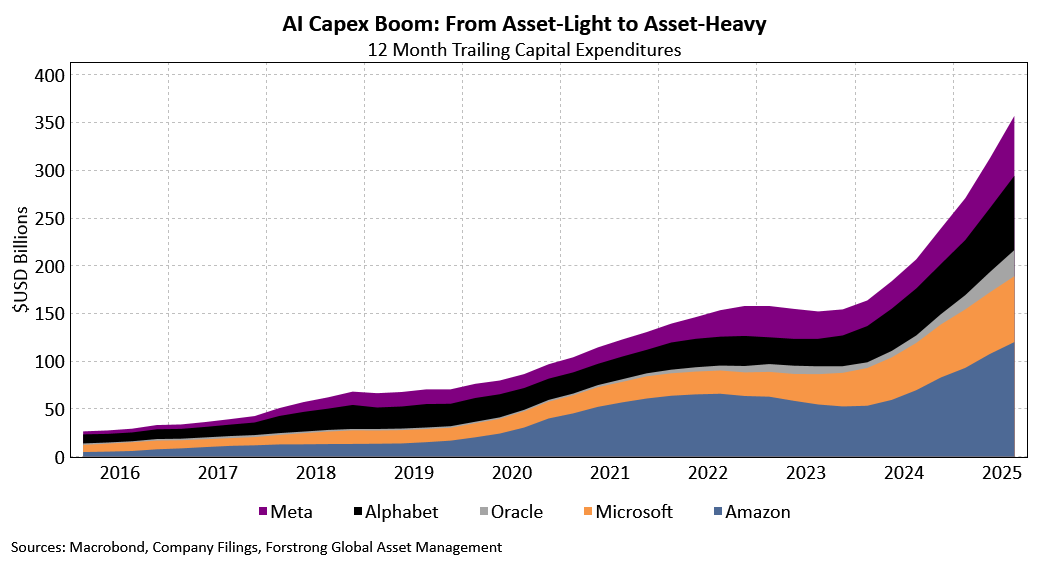
Yet K-shaped patterns extend far beyond these divides. Contradictions abound. Booming versus faltering states. A Eurozone where the periphery once struggled and now it’s the core. A tech sector once celebrated for its capex-light business model that’s now the opposite. America’s largest city is now governed by its first millennial-socialist-Democrat mayor, Zohran Mamdani, while Republicans still control the White House. Trump’s tariffs — at their highest level in 90 years — seem to be hitting neither prices nor profits (US companies’ earnings are growing at the fastest pace in four years).
Everywhere you look, the alphabet of anomalies keeps expanding.
K-Shaped And Complicated
The muddled macro backdrop is mirrored in financial markets. The dual rally in stocks and gold speaks to both risk appetite and the desire for protection: investors are chasing risk and hedging it at the same time. Public markets are euphoric, while many corners of private markets, once the darlings of the asset management world (and once free from those pesky things like transparency and price discovery), are being dramatically marked down. And perhaps most paradoxically, countries with the highest tariff rates imposed on them are posting some of the best-performing equity markets this year.
The end result is confusion. Economists and investors, depending on their vantage point, can look at the same economy and land on a broad range of views. The US economy seems both unstoppable and vulnerable. Trump’s policy agenda appears to be simultaneously jarring and oddly inconsequential. Markets feel euphoric yet uneasy — a bull market that constantly looks over its own shoulder.
It’s an environment ripe for error. What data points actually matter? K-shaped dynamics make it hard to see the net effects, driving macro uncertainty and polarized debate. Take AI. The split between the true believers and the skeptics has never been wider. Unsurprisingly, AI-related stocks hit an air pocket in August after an MIT study found that 95% of generative AI projects have failed to deliver a measurable financial return.
Investors today are watching a split-screen economy with differing narratives flickering on and off — a constant tussle of facts and opinions seemingly pulling in opposite directions.
Investment Implications: Investing in a Split-Screen World
What’s the right response to all this? Investors should never feel pressure to get the outlook exactly right. Investing isn’t a game of precision. Rather, the goal should be to tilt portfolios toward the highest probabilities, pick your spots to take risk, all while balancing risks and opportunities.
For every K-shaped distortion in today’s economy, there’s another way to look at it — and position around it. Cycles built on extremes never last. The task now is to move from the obvious winners toward the overlooked beneficiaries — where new leadership is quietly emerging.
Below, we outline Forstrong’s key ideas, organized around 3 pillars: Protection, Income, and Growth.
Protection: Crypto vs. Gold — The New Debasement Debate
A new divide is emerging in the so-called “debasement trade”: crypto versus gold. Both assets express the same unease — distrust of policy orthodoxy, desire for assets outside the traditional monetary system and, concern over ballooning government debt and unchecked fiscal stimulus in developed economies. These are long-term, secular themes.
But recent price action tells the story best. Crypto thrives on speculation, rising and falling with risk appetite. Gold, by contrast, thrives on uncertainty. It also has a reliable, price-insensitive buyer: foreign governments. Since Russia’s 2022 invasion of Ukraine, central banks, particularly in the Global South, have been persistent accumulators even as Western ETFs have been net sellers.
Actionable: Even after a strong run and volatility, investors should maintain exposure to precious metals. The gold bull market has broadened to silver and platinum — even industrial commodities like copper are showing signs of joining the rally (and would have different macro drivers for return). Historically, only a sharply hawkish Fed or a surging US dollar has stopped such moves. Neither appears likely now.
Income: Beyond the Crowded Trades
Despite multiple sources of potential volatility, credit markets remain oddly tranquil. US and Canadian spreads — investment-grade and high-yield alike — are hovering near record lows. Meanwhile, private credit, which flourished after the post-2008 Dodd-Frank reforms curtailed bank lending, is now under scrutiny over liquidity and credit quality.
Elsewhere, opportunities look far more compelling. Many regions outside North America offer higher real yields, improving fundamentals, and, with a softer US dollar, potential currency tailwinds. In a world where Western central banks seem content living with 3% inflation, global income diversification will be a winning strategy.
Actionable: Reduce exposure to North American debt structures and look abroad for yield. Select emerging market debt, handily outperforming in 2025, remains a key source of stable and rising income.
Growth Investors: From American AI to Global Broadening
The temptation to chase AI stocks is understandable. A US industrial boom, courtesy of artificial intelligence, is underway, even if it’s not the jobs-rich manufacturing revival once promised. AI’s allure is simple: it promises a powerful boost to productivity. In the first half of 2025, output per hour in the US durable goods sector grew at an annualized 4.9% — the fastest in nearly two decades outside post-recession rebounds.
But investors now seem convinced that America’s AI lead is permanent. Growth expectations embedded in US stock valuations are near century highs, rivaled only by the late 1990s dot-com bubble. Foreign investors have piled in, pouring a record $290 billion into US equities in the second quarter, pushing foreign ownership to 30% — the highest level since World War II. When all this changes is anyone’s guess. But it cannot be ignored that a massive amount of money has been shoved to the middle of the table, and if the cards don’t come up right, the downside will be significant.
Meanwhile, a different dynamic is unfolding elsewhere. Trump’s “America First” agenda has forced other nations to respond — with higher fiscal spending, competitiveness reforms, and fresh trade alliances. We’ve written extensively about this “Protectionist Paradox”, which is now reshaping global investment flows. Policymakers abroad see AI not as America’s advantage but as the great equalizer. The uneven recovery of recent years has laid the groundwork for a powerful global broadening.
Actionable: Trim exposure to crowded corners of the US AI trade and lean into international markets with better value and rising momentum. Focus on countries with room to ease policy, solid external balances, and less stretched positioning. Asia, in particular, stands out as one of the most attractive destinations for capital.
Escaping The Two-Speed Trap
Every cycle eventually runs out of road. The past few years have been defined by speed — policy accelerants, technological leaps, and speculative bursts. But this so-called K-economy has crowded investors into the same fast lane, leaving vast stretches of opportunity wide open elsewhere.
Now comes the rotation phase — not the end of the cycle, but the broadening of it. The world is shifting from speed to balance, from narrow US leadership to global participation. For investors, the smartest move isn’t to slam the brakes but to change lanes before everyone else does.

The information contained in these materials is for general informational purposes only and is intended to provide only brief comments on broad market, industry or sector trends, or other general economic or market conditions. It is not intended to provide an overview of the terms applicable to any products or funds managed or sponsored by Forstrong Global Asset Management Inc. (“Forstrong”). Views expressed regarding a particular company, security, industry, investment, or market sector are the views only of that individual as of the time expressed and do not necessarily represent the views of Forstrong or any other person in the Forstrong organization. These materials contain information and views as of the date indicated and such information and views are subject to change at any time without notice, based upon market and other conditions, and Forstrong disclaims any and all responsibility to update such information and views. These views are not and may not be relied upon as investment advice and, because investment decisions for a Forstrong fund or product are based on numerous factors, are not and should not be relied upon as an indication of trading intent on behalf of any Forstrong fund or product. Any opinion or assumption may contain elements of subjective judgment and are not intended to imply, nor should be interpreted as conveying, any form of guarantee or assurance by Forstrong of any future action or performance. Neither Forstrong nor any of its affiliates, businesses, or representatives make any representation or warranty, express or implied, as to the accuracy, reliability, completeness, appropriateness, or sufficiency for any purpose of any information contained herein. Forstrong and its affiliates and related entities disclaim any and all liability relating to the information herein, including, without limitation, any express or implied representations or warranties for, statements contained in, and omissions from, the information. Forstrong and its affiliates and related entities are not liable for any errors or omissions in any information herein or for any loss or damage suffered, whether direct or consequential, resulting from the use of these materials.
The information contained in these materials is strictly for general illustrative, educational, or informational purposes, and is not intended to provide legal, investment, accounting, or tax advice, and should not be relied upon in that regard. These materials contain information and views as of the date indicated and such information and views are subject to change at any time without notice, based upon market and other conditions, and Forstrong disclaims any and all responsibility to update such information and views. These views are not and may not be relied upon as investment advice. Any opinion or assumption may contain elements of subjective judgment and are not intended to imply, nor should be interpreted as conveying, any form of guarantee or assurance by Forstrong of any future action or performance. Neither Forstrong nor any of its affiliates, businesses, or representatives make any representation or warranty, express or implied, as to the accuracy, reliability, completeness, appropriateness, or sufficiency for any purpose of any information contained herein. Forstrong and its affiliates and related entities disclaim any and all liability relating to the information herein, including, without limitation, any express or implied representations or warranties for, statements contained in, and omissions from, the information. Forstrong and its affiliates and related entities are not liable for any errors or omissions in any information herein or for any loss or damage suffered, whether direct or consequential, resulting from the use of these materials.
Any specific companies, issuers, funds, ETFs, or indices mentioned are for illustrative or educational purposes only and are not and shall not be deemed to be a recommendation to buy or sell any securities. Any companies, issuers, funds, or ETFs mentioned do not necessarily represent current or future holdings of any Forstrong funds or products. Any strategies discussed are strictly for illustrative and educational purposes and are not a recommendation, offer, or solicitation to buy or sell any securities or to adopt any investment strategy. There is no guarantee that any strategies discussed will be effective.
Commissions, fees, and expenses may be associated with investments in Forstrong funds, ETFs, and/or other investment products. Please read a fund’s offering memorandum or ETF’s prospectus, as applicable, which contains detailed information, and speak to an advisor before investing. Funds and ETFs are not guaranteed, their values change frequently, and investors may experience a gain or loss. Past performance may not be repeated.
Certain statements in these materials may contain forward-looking statements or forward-looking information that are predictive in nature and may include words such as “expects”, “anticipates”, “intends”, “plans”, believes”, “estimates”, and similar forward-looking expressions or negative versions thereof. Such forward-looking statements are based on current expectations and projections about future general economic, political, and other relevant market factors, such as interest, and assuming no changes to applicable tax or other laws or regulations. Expectations and projections about future events are inherently subject to, among other things, risks and uncertainties, some of which may be unforeseeable and, accordingly, may prove to be incorrect at a future date. Forward-looking statements are not guarantees of future performance, and actual events could differ materially from those expressed or implied in any forward-looking statements. A number of important factors can contribute to these differences, including, but not limited to, general economic, political, and market factors in Canada and internationally, interest and foreign exchange rates, global equity and capital markets, business competition, and catastrophic events. You should avoid placing any undue reliance on forward-looking statements. Past performance is no indicator of future performance and the materials are not intended to forecast or predict future events. Forstrong disclaims any and all responsibility to update any forward-looking statements, whether as a result of new information, future events, or otherwise, except as specifically required by law.
The information contained herein is presented solely for illustrative purposes and should not be construed as a forecast or projection. While some information used herein has been obtained from various published and unpublished third-party sources considered to be reliable, such information has not been independently verified by Forstrong (and Forstrong disclaims any obligation to verify) and Forstrong does not guarantee its accuracy or completeness and accepts no liability for any loss or damage suffered, whether direct or consequential, resulting from its use. It should be noted that data provided may be approximate numbers.
Forstrong Global® and the Forstrong Global® logo are trademarks or registered trademarks of Forstrong Global Asset Management Inc. in Canada.
© 2025 Forstrong Global Asset Management Inc. All rights reserved.