
Ask Forstrong
Commodity Markets
Breakout
January 2026
Ask Forstrong: What do you make of last year’s robust action in commodity markets? Can it continue in 2026?
Key Takeaways
- After a decade-plus bear market, 2025 marked a decisive turning point for commodity prices.
- A powerful new cycle is taking shape — driven by resilient global growth, structural underinvestment, and a rising “debasement mindset.”
- Global allocators should be overweight commodity-oriented equities, with particular emphasis on industrial metals such as copper.
Welcome back to the pages of Ask Forstrong, dear readers. It has taken 14 years, substantial capital outlays, repeated setbacks, and more than a few wildly optimistic forecasts — but over the holidays, a genuine productivity breakthrough finally arrived: my teenage son made his own dinner. I missed the action, but the post-mortem was favourable: a structurally coherent quesadilla, the kitchen still standing, and no frantic call to the fire department.
Another breakthrough — this one with far broader consequences — also appeared in 2025: commodities came back to life. Nearly everything across the periodic table rallied. Precious metals surged. Copper posted its strongest annual gain since 2009, driven by stubborn supply bottlenecks and insatiable demand from electrification to AI-driven data centre build-outs. Crude oil was the lone laggard, held back by an OPEC-led supply flood.
What to make of all this? It has been a long and grinding bear market for a wide swath of resource prices — the broad complex last peaked in 2011 (incidentally the same year my firstborn arrived). But 2025 marked a clear regime shift. Surging commodity prices are signalling something important.
Here’s what they’re saying:
1. Resilient Global Growth
The first message is the simplest: the global economy continues to outperform the widespread and persistent prophecies of doom. 2025 delivered no shortage of alarming headlines — including America’s highest tariff rates since the 1930s, with the average rate now seven times higher than a year earlier. Yet rather than derailing global growth, Trump’s tariffs triggered reactionary waves of domestic stimulus abroad, igniting equity rallies and propping up local demand. We called this the Protectionist Paradox, and as recent media coverage noted, it remains very much alive.
But the pattern should now be obvious: governments everywhere are spending their way out of political predicaments. In America, having damaged business confidence with his tariff barrage, Trump has pivoted to tax cuts. Many households will soon receive tax rebates, delivering a front-loaded fiscal boost that more than offsets last year’s policy shocks. The most reliable macro forecasting rule still holds: when American consumers receive money, they spend it. And if these rebates don’t lift Trump’s approval, expect fresh stimulus ahead of the 2026 midterms.
Elsewhere, fiscal taps are equally open. Even Germany has joined the spending party, rolling out a €500bn package — roughly 12% of GDP — an extraordinary pivot for a country once synonymous with austerity. Across the developed world, governments are now running deficits normally reserved for fighting deep recessions.
Fiscal easing is also being met with monetary accommodation. The US Federal Reserve now faces pressure to act as a “national champion” and bring rates down. Markets have correctly priced an asymmetry in Fed behaviour: there are very few scenarios where the Fed hikes in 2026, but it will move quickly and aggressively to cut if downside risks appear. That bias forces other central banks to follow — lest yield-hunters drive up their currencies and crush exporters.
OECD leading indicators are now turning higher. Often lost in the headlines is that the world’s two largest engines of growth outside America — China and Europe — are only now emerging from their post-Covid slumps. Europe is now in a solid cyclical recovery. Importantly, China, the planet’s biggest commodity customer, has turned a major corner after years of regulatory crackdowns and a deflating property sector.
This overall backdrop is constructive for pro-growth assets such as commodities. As 2026 progresses, investors will soon hear more words beginning with “R”: reflation, reacceleration, and regime shift.
2. Structural Underinvestment: Revenge of the Real Economy
Years of chronic underinvestment — especially in mining and energy — have left the world short of nearly everything that matters. Electrification, grid upgrades, data-centre build-outs, AI infrastructure, defence spending: all of it requires metals, materials and energy. Even modest demand now runs head-first into supply chains that simply cannot ramp up quickly.
This is a new world: the marginal unit of global growth is once again resource-intensive. We call this the Revenge of the Real Economy — a key Super Trend in our 2026 Investment Outlook. One of the least appreciated shifts underway is that the world’s largest companies — US Big Tech — are quietly abandoning their capital-light business models. Future growth now depends on data centres, transmission lines, power generation and physical infrastructure. Silicon Valley is rediscovering physics.
More broadly, the world is in a global race to reindustrialize. Structural forces — decarbonization, supply-chain reshoring, national industrial strategies and rising geopolitical tension — are pulling capital away from purely digital projects and toward physical economic rebuilding. Governments are directing staggering sums toward energy systems, transport networks, grid reinforcement, manufacturing capacity and engineering capabilities. The pandemic killed the austerity reflex and expanded political appetite for large-scale fiscal programs that favour domestic resilience over cost minimization.
This renewed focus on the real economy is reversing many of the deflationary impulses that defined the 2010s. As fiscal firepower collides with rising industrial demand, capacity constraints are emerging in everything from metals (it takes 10–15 years to bring a new copper mine online) to specialized labour (over the last decade, how many of our best and brightest youth went into the resource extraction business instead of trying to get an algorithmic stablecoin to work?). These bottlenecks are not temporary; they are the predictable result of a world reinvesting in itself after a long period of neglect.
Commodity cycles themselves are long. The last supercycle ran from 2001 to 2011. The one before that, from 1968 to 1980. These cycles typically last about a decade and unfold in three phases. First, rising prices restore confidence. Second, resource companies start spending again, driving cost inflation and pushing prices higher. Third, the system is de-bottlenecked as new supply finally arrives — eventually cooling prices. We are still firmly in phase one.
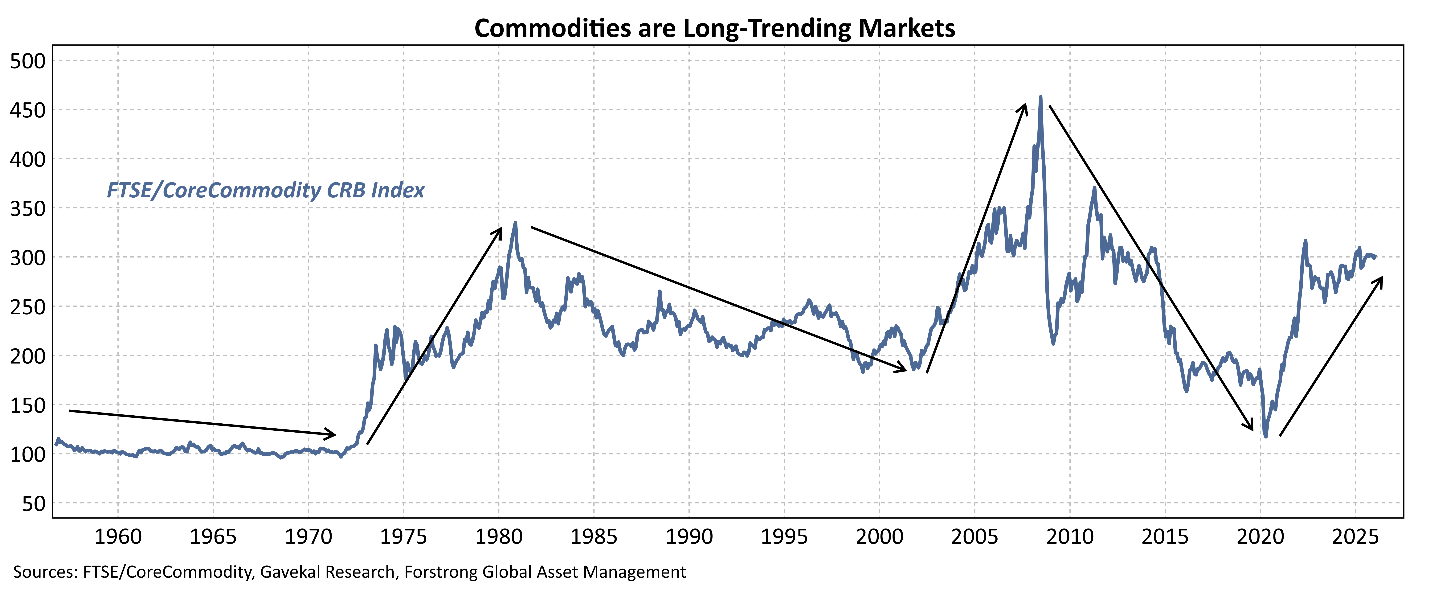
3. Vibe Shift: A “Debasement Mindset” Has Taken Hold
The final signal from commodities is more subtle — but no less powerful.
After the 2008 Global Financial Crisis, investors spent a decade in a defensive crouch. Risk-taking collapsed. Interest rates fell. The US dollar stayed chronically strong. Commodity prices sagged. The prime directive was simple: protect principal.
That world is gone. Investors have now absorbed an unavoidable truth: massive government spending is not a temporary aberration — it is the playbook (and they may also have noticed that a meaningful share of the political class appears to be operating with a prefrontal cortex still in early development). Most importantly, they understand inflation will run structurally hotter than the sub-2% regime of the 2010s.
The result: a debasement mindset is taking hold. Investors no longer want to sit on high cash balances. They recognize the need for tangible assets in portfolios — assets tied to real economic value rather than political promises.
Markets are doing the talking. In 2025, numerous industrial metals posted double-digit gains. Copper surged more than 35%. Gold delivered its strongest performance since 1979. Meanwhile, the US dollar index suffered its worst six-month decline in more than 50 years and ended the year down roughly 11% for the year, making it the weakest performer among 17 major global currencies.
History is unambiguous here: sustained dollar weakness is rocket fuel for resource prices. The last dollar downcycle in the early 2000s (those who were there remember it well) powered a multi-year commodity boom. The same conditions are now lining up again.
Investment Implications
Markets remain fixated on America’s mega-cap AI champions — and appear convinced that the US lead in AI is both permanent and unassailable. Growth expectations embedded in US equity valuations are now approaching century highs, rivalled only by the late-1990s dot-com era. That narrow focus has left an enormous opportunity set hiding in plain sight.
A broader regime change is underway. Real assets, commodities, infrastructure and income-producing resource sectors are reclaiming a central role in diversified portfolios. These are slow-moving, supply-intensive, globally coordinated investment cycles — the exact opposite of the intangible-driven tech surges that defined the last decade.
For investors, the implications are straightforward:
- Own Atoms: Increase exposure to commodities, infrastructure and real-asset equities benefitting from capex cycles. They lagged last cycle but will lead this one.
- Play the Bottlenecks: Focus on supply-constrained metals essential to electrification — especially copper. Expect more large mergers (e.g., Anglo American + Teck) to unlock shareholder value, along with opportunities in major national exporters in Latin America and Southeast Asia.
- Hedge with Real Assets: Use precious metals to protect portfolios from sticky inflation and geopolitical volatility. Expect high volatility but remain strategically invested.
Forstrong client portfolios are already positioned for this shift — and have benefited meaningfully over the past year. Looking for the right word to capture what’s unfolding in commodities, I sought counsel from my in-house expert: my 14-year-old son.
His assessment? “It’s cooking, Dad.”
He’s not wrong. This cycle is only warming up. Don’t miss it.
Looking for perspective beyond the headlines?

Disclaimers:
The information contained in these materials is for general informational purposes only and is intended to provide only brief comments on broad market, industry or sector trends, or other general economic or market conditions. It is not intended to provide an overview of the terms applicable to any products or funds managed or sponsored by Forstrong Global Asset Management Inc. (“Forstrong”). Views expressed regarding a particular company, security, industry, investment, or market sector are the views only of that individual as of the time expressed and do not necessarily represent the views of Forstrong or any other person in the Forstrong organization. These materials contain information and views as of the date indicated and such information and views are subject to change at any time without notice, based upon market and other conditions, and Forstrong disclaims any and all responsibility to update such information and views. These views are not and may not be relied upon as investment advice and, because investment decisions for a Forstrong fund or product are based on numerous factors, are not and should not be relied upon as an indication of trading intent on behalf of any Forstrong fund or product. Any opinion or assumption may contain elements of subjective judgment and are not intended to imply, nor should be interpreted as conveying, any form of guarantee or assurance by Forstrong of any future action or performance. Neither Forstrong nor any of its affiliates, businesses, or representatives make any representation or warranty, express or implied, as to the accuracy, reliability, completeness, appropriateness, or sufficiency for any purpose of any information contained herein. Forstrong and its affiliates and related entities disclaim any and all liability relating to the information herein, including, without limitation, any express or implied representations or warranties for, statements contained in, and omissions from, the information. Forstrong and its affiliates and related entities are not liable for any errors or omissions in any information herein or for any loss or damage suffered, whether direct or consequential, resulting from the use of these materials.
The information contained in these materials is strictly for general illustrative, educational, or informational purposes, and is not intended to provide legal, investment, accounting, or tax advice, and should not be relied upon in that regard. These materials contain information and views as of the date indicated and such information and views are subject to change at any time without notice, based upon market and other conditions, and Forstrong disclaims any and all responsibility to update such information and views. These views are not and may not be relied upon as investment advice. Any opinion or assumption may contain elements of subjective judgment and are not intended to imply, nor should be interpreted as conveying, any form of guarantee or assurance by Forstrong of any future action or performance. Neither Forstrong nor any of its affiliates, businesses, or representatives make any representation or warranty, express or implied, as to the accuracy, reliability, completeness, appropriateness, or sufficiency for any purpose of any information contained herein. Forstrong and its affiliates and related entities disclaim any and all liability relating to the information herein, including, without limitation, any express or implied representations or warranties for, statements contained in, and omissions from, the information. Forstrong and its affiliates and related entities are not liable for any errors or omissions in any information herein or for any loss or damage suffered, whether direct or consequential, resulting from the use of these materials.
Any specific companies, issuers, funds, ETFs, or indices mentioned are for illustrative or educational purposes only and are not and shall not be deemed to be a recommendation to buy or sell any securities. Any companies, issuers, funds, or ETFs mentioned do not necessarily represent current or future holdings of any Forstrong funds or products. Any strategies discussed are strictly for illustrative and educational purposes and are not a recommendation, offer, or solicitation to buy or sell any securities or to adopt any investment strategy. There is no guarantee that any strategies discussed will be effective.
Commissions, fees, and expenses may be associated with investments in Forstrong funds, ETFs, and/or other investment products. Please read a fund’s offering memorandum or ETF’s prospectus, as applicable, which contains detailed information, and speak to an advisor before investing. Funds and ETFs are not guaranteed, their values change frequently, and investors may experience a gain or loss. Past performance may not be repeated.
Certain statements in these materials may contain forward-looking statements or forward-looking information that are predictive in nature and may include words such as “expects”, “anticipates”, “intends”, “plans”, believes”, “estimates”, and similar forward-looking expressions or negative versions thereof. Such forward-looking statements are based on current expectations and projections about future general economic, political, and other relevant market factors, such as interest, and assuming no changes to applicable tax or other laws or regulations. Expectations and projections about future events are inherently subject to, among other things, risks and uncertainties, some of which may be unforeseeable and, accordingly, may prove to be incorrect at a future date. Forward-looking statements are not guarantees of future performance, and actual events could differ materially from those expressed or implied in any forward-looking statements. A number of important factors can contribute to these differences, including, but not limited to, general economic, political, and market factors in Canada and internationally, interest and foreign exchange rates, global equity and capital markets, business competition, and catastrophic events. You should avoid placing any undue reliance on forward-looking statements. Past performance is no indicator of future performance and the materials are not intended to forecast or predict future events. Forstrong disclaims any and all responsibility to update any forward-looking statements, whether as a result of new information, future events, or otherwise, except as specifically required by law.
The information contained herein is presented solely for illustrative purposes and should not be construed as a forecast or projection. While some information used herein has been obtained from various published and unpublished third-party sources considered to be reliable, such information has not been independently verified by Forstrong (and Forstrong disclaims any obligation to verify) and Forstrong does not guarantee its accuracy or completeness and accepts no liability for any loss or damage suffered, whether direct or consequential, resulting from its use. It should be noted that data provided may be approximate numbers.
Forstrong Global® and the Forstrong Global® logo are trademarks or registered trademarks of Forstrong Global Asset Management Inc. in Canada.
© 2026 Forstrong Global Asset Management Inc. All rights reserved.